

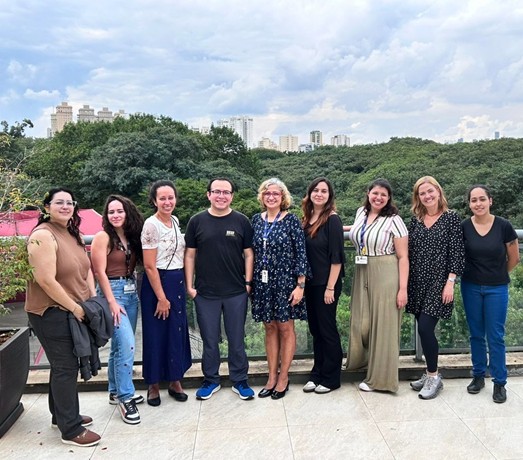
International training combined biodiversity, R programming, and satellite tools to investigate environmental factors associated with the emergence of diseases and emerging pathogens.
Researchers and students from the Institut Pasteur de São Paulo (IPSP) participated, between April 22 and 29, in a training program focused on the integrated use of ecological analysis, programming, and satellite tools to investigate environmental factors associated with the emergence of zoonoses and new pathogens. The training enabled participants to learn techniques capable of correlating species diversity, environmental changes, and the circulation of infectious agents across different territories.
The training took place through the course “Introduction to Species Diversity Analysis with R and Satellite Tools,” taught by Dr. Roman Espinal Palomino, researcher at the Center for Research and Advanced Studies of the National Polytechnic Institute (Cinvestav), Mexico. The activities combined theoretical and practical content involving biological diversity analysis, R programming, and the use of geospatial tools such as QGIS.
The program brought together participants from different IPSP research groups and focused on ecological data analysis, including aspects related to sampling, data quality, and interpretation of species diversity.
According to Palomino, one of the main objectives of the course was to bring ecological tools closer to research focused on the surveillance and discovery of new pathogens, allowing a better understanding of the environmental factors associated with the emergence of infectious diseases.
“In recent years, knowledge in the field of diversity studies has grown significantly. The proposal is to apply this knowledge to the context of searching for new pathogens, enabling the generation of estimates about what has already been identified and what may still be discovered,” explains the researcher.
The integration between statistical analysis in R and geospatial tools such as QGIS allows researchers to investigate questions related to the influence of urbanization, environmental changes, and land occupation on wildlife and pathogen circulation.
Among the issues discussed during the course were the effects of urbanization on the emergence of diseases in wildlife, differences in pathogen diversity between urban and conserved environments, and the study of interaction networks among potential reservoirs and hosts.
The training also addressed the One Health concept, which integrates human, animal, and environmental health and is currently considered strategic for studies on zoonoses and preparedness for future pandemics.
“Surveillance through the use of molecular tools greatly facilitates the search for new pathogens, especially those related to zoonotic events,” says Palomino. According to him, satellite tools also allow real-time monitoring of potential infection hotspots and the identification of environmentally critical areas for wildlife.
Another aspect highlighted by the researcher was the applied nature of the training, allowing participants to work with their own data during the practical activities.
The initiative was made possible through international collaboration between the UNU Biotechnology Programme for Latin America and the Caribbean, the Laboratorio de Pato-Ecología Rural y Urbana (PERU-Lab) – Cinvestav Mérida, and IPSP, through the Spillover and One Health research group led by researcher Dr. Angélica Cristine de Almeida Campos.