
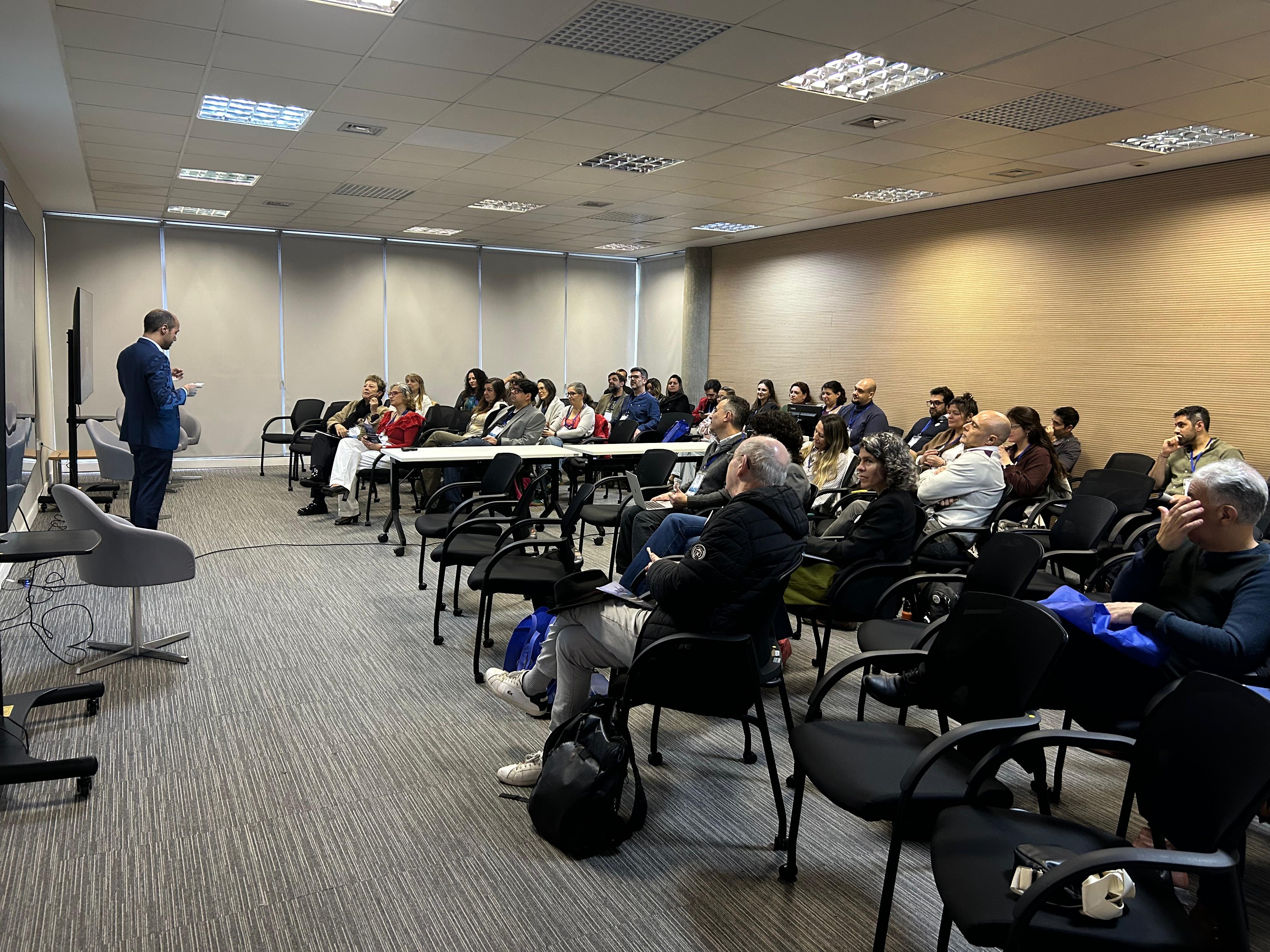
Researchers from Montevideo and São Paulo presented studies on toxoplasmosis, disease susceptibility, influenza, emerging viruses, and new surveillance strategies involving human and animal populations and the environment.
The scientific presentations held on the morning of the first day of the IPSP & IPMon – A Pasteurean Scientific Meeting (September 16) showcased different strategies for understanding, detecting, and anticipating infectious diseases. During the session entitled “One Health, Viral Emergence and Environmental Surveillance,” researchers from the Institut Pasteur de São Paulo (IPSP) and the Institut Pasteur de Montevideo (IPMon) presented work ranging from the genetic diversity of parasites and multi-omics analyses of populations to influenza surveillance in wastewater and the search for emerging viruses in wildlife and urban animals.
Representing the Institut Pasteur de Montevideo, Maria E. Francia showed how knowledge of Toxoplasma gondii diversity can be translated into solutions for animal health. Her group focuses particularly on vertical transmission of the parasite, from mother to fetus, as well as on differences among strains circulating in different regions.
The laboratory uses placental organoids, animal models, functional genomics, and tools such as CRISPR/Cas9 to investigate which parasite and host factors determine the ability of Toxoplasma to cross the placenta and establish infection. The researchers have also demonstrated that local strains can behave quite differently in terms of growth, virulence, and their ability to establish chronic infection.
This diversity is also being explored for practical applications. The group has developed a diagnostic tool for ovine toxoplasmosis using local strains, with the aim of improving the ability to detect infections in the region. Another line of research uses conserved components of the Toxoplasma cell-invasion machinery to develop an experimental vaccination strategy designed to reduce vertical transmission in animals.
Researcher Natalia Rego, also from IPMon, addressed another challenge: how to integrate genomic, transcriptomic, and clinical data to understand differences in disease susceptibility. One example involved people living with HIV who are able to maintain very low or undetectable viral loads without antiretroviral treatment. The analyses suggest the existence of viral restriction mechanisms capable of controlling the virus without triggering an intense inflammatory response.
Rego also showed how multi-omics approaches can improve diagnostic capacity for rare diseases by combining DNA and RNA sequencing, clinical information, and computational tools. A central point of her presentation was the need to take the genetic ancestry of populations into account. Reference databases built predominantly with individuals of European ancestry may lead to inappropriate interpretations when applied to admixed populations.
In this context, she presented LatinCells, a consortium created to increase Latin American representation in immunological and genomic studies. The project includes participants from eight countries and more than 2.5 million immune cells analyzed individually. The data show that genetic ancestry leaves measurable signatures on the functioning of the immune system.
Building on this foundation, the group intends to move from the characterization of healthy populations to the study of disease. One of its new projects will investigate how metabolic syndrome alters the immune system and may increase vulnerability to infections, integrating cohorts from Uruguay and Brazil.
Institut Pasteur de São Paulo
Representing the Institut Pasteur de São Paulo, Angélica Campos opened the institute’s scientific presentations by addressing influenza virus surveillance in birds, bats, and other animals from a One Health perspective. She showed how influenza can circulate among different species and highlighted the role of migratory birds and other reservoirs in viral spread.
Campos presented mechanisms of influenza evolution, including antigenic drift and antigenic shift, and emphasized the importance of monitoring viruses such as H5N1. Her project includes animal sampling, molecular analyses, and phylogenetic studies to identify circulating viruses and assess the risks of cross-species transmission.
Influenza surveillance was also at the center of Rúbens Alves’s presentation, but in a different setting: wastewater. Alves showed that wastewater samples can provide information about viral circulation in large populations, including asymptomatic individuals and people who do not seek healthcare services.
In a comparison of methods, digital PCR showed greater sensitivity for detecting influenza A and B than conventional RT-qPCR. The network monitored by the group, in partnership with CETESB, analyzed hundreds of samples from different locations across the state of São Paulo. According to the data presented, in some locations the increase in viral signals in wastewater preceded the clinical peak by up to several weeks.
The project is also advancing toward the genomic characterization of viruses detected in wastewater and the creation of a platform capable of monitoring approximately 200 RNA and DNA viruses within the same sampling network. The goal is for this infrastructure to serve as a permanent sentinel system, allowing the pathogens under surveillance to be adjusted according to epidemiological risks.
The viral diversity of Brazilian wildlife was the focus of Gustavo Góes’s presentation. His group conducts field expeditions to collect samples from bats, marsupials, and other mammals and investigate viruses that remain poorly understood. Among the findings presented were different coronaviruses detected in Brazilian bats, some genetically related to groups that include viruses of medical importance, as well as paramyxoviruses, hantaviruses, and arenaviruses.
Beyond discovering new viruses, the objective is to assess their zoonotic potential: whether they are capable of infecting human cells, replicating in them, evading the immune response, and potentially posing a risk of emergence. This work is particularly relevant in a country such as Brazil, where high biodiversity, environmental change, and increasing contact between people and wildlife create conditions for cross-species transmission events.
Concluding this set of presentations, Robert Andreata-Santos presented a surveillance strategy focused on urban rodents. His laboratory primarily studies Rattus rattus and Rattus norvegicus, animals that live in close contact with human populations and can serve as sentinels for viral circulation in cities.
In addition to capturing animals and analyzing tissues, the group has begun using feces collected in infested areas as a source for environmental surveillance. Preliminary findings detected astroviruses in some samples and coronaviruses in rodents collected in Salvador, in collaboration with researchers from the Federal University of Bahia (UFBA).
The project aims to integrate these data with human clinical information, environmental characteristics, and social indicators such as income, sanitation, population density, and seasonality. The goal is to use bioinformatics and artificial intelligence to generate risk maps and transform urban rodent surveillance into a tool to support public health.
Taken together, the presentations highlighted complementary approaches to the same challenge: identifying risks before they develop into public health emergencies, whether by monitoring viruses in animals, the environment, or human populations, or by developing tools capable of better interpreting the region’s biological and genetic diversity.