
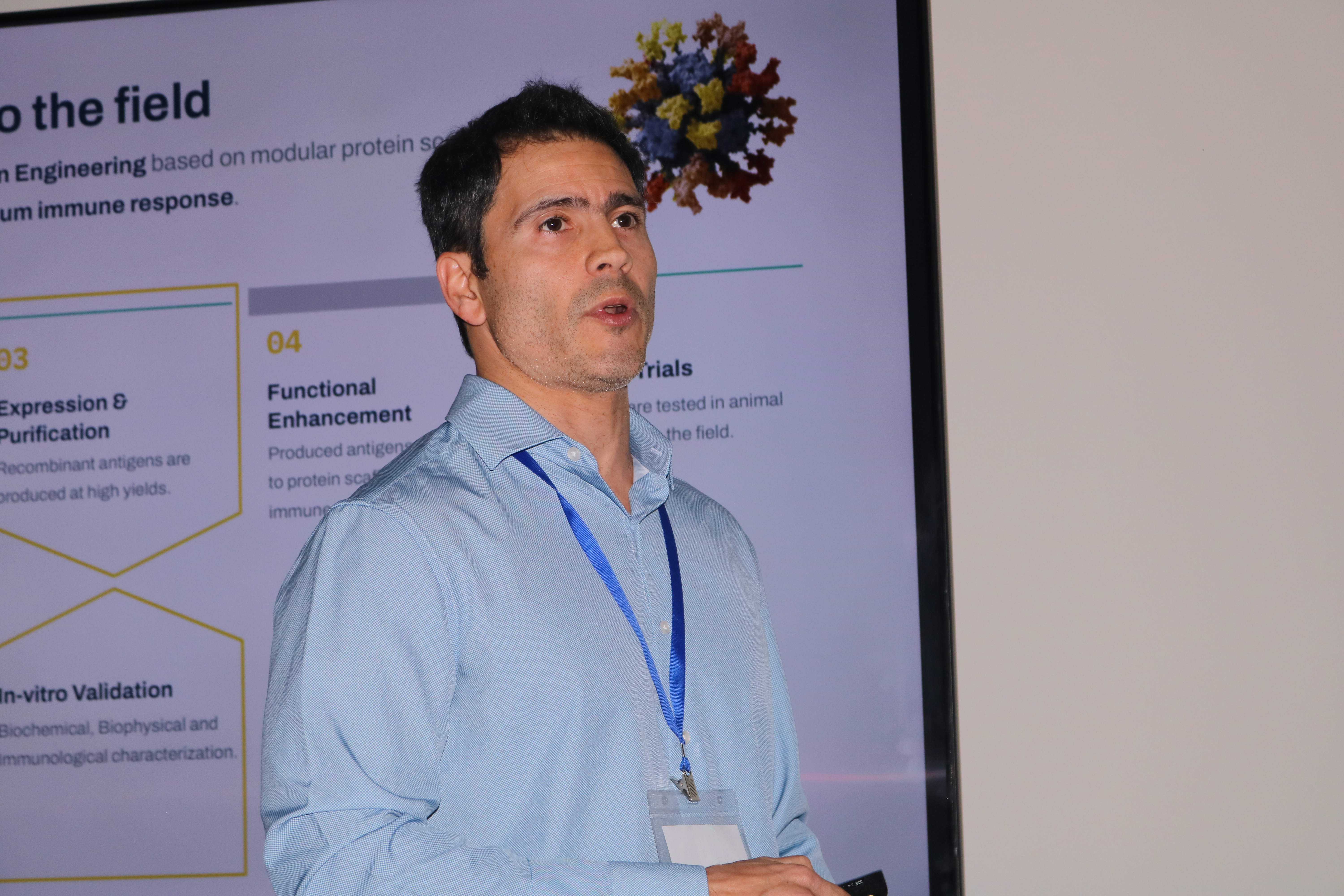
The presentations connected basic research, computational approaches and technological development in the search for new solutions to human and animal health challenges.
The afternoon program on the second day of the “Institut Pasteur de São Paulo & Institut Pasteur de Montevideo: A Pasteurean Scientific Meeting,” held from September 16 to 18 at the University of São Paulo (USP), brought together research focused on the development of new strategies in vaccines, viral engineering, antivirals and computational modeling, with applications to issues of importance for human and animal health.
Matias Machado, from the Institut Pasteur de Montevideo (IPMon), presented a protein-engineering platform for the development of subunit vaccines. He showed how bioinformatics and artificial intelligence tools are being used to design more stable and immunogenic antigens, with a particular focus on a vaccine against the cattle tick Rhipicephalus microplus.
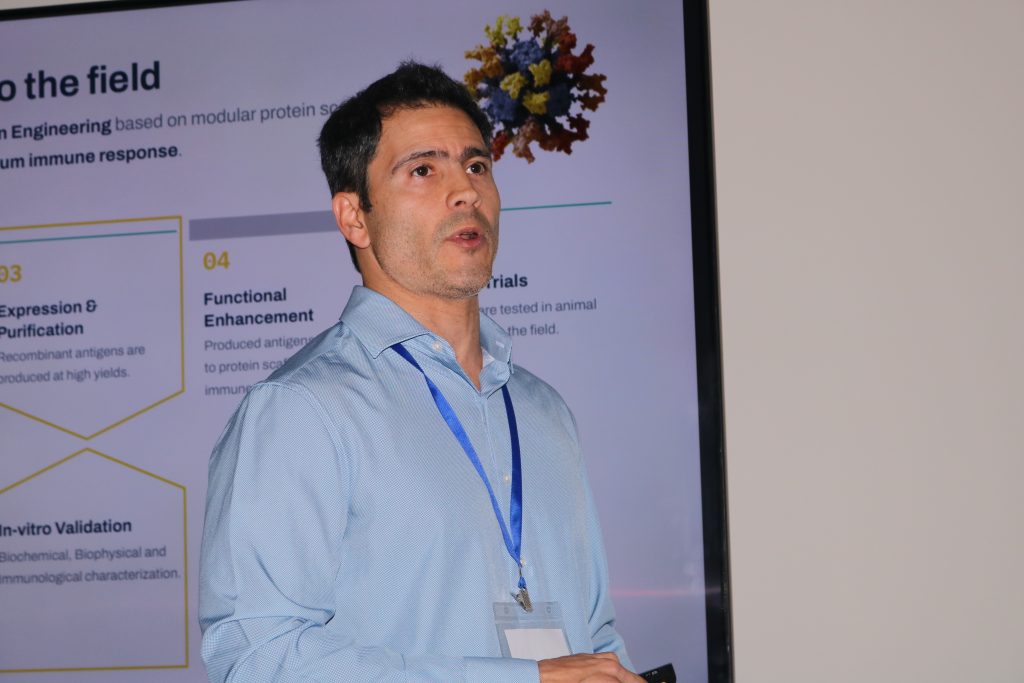
Matias Machado (IPMon)
The results presented showed substantial improvements in the stability of the engineered proteins and high levels of efficacy in field studies conducted in Uruguay, highlighting the potential of combining molecular engineering with applied research to address animal-health challenges of major economic importance to livestock production.
Alvaro Fajardo discussed different genetic-engineering strategies applied to RNA viruses. Using models such as coxsackievirus, Mayaro virus and influenza A, he showed how targeted genetic modifications can reduce viral virulence, restrict replication to specific tissues or transform viruses into tools for biomedical research. Examples included approaches based on codon modification to generate attenuated viruses, the use of microRNAs to regulate viral replication and the construction of reporter viruses capable of tracking infection dynamics in experimental models.
Martin Flo’s presentation focused on retrovirus research, particularly bovine leukemia virus (BLV). He described efforts to understand the molecular mechanisms involved in viral infection and identify new compounds capable of blocking the activity of viral protease, an enzyme essential for virus maturation. The studies combine structural characterization of proteins, computational and experimental screening of molecules, and cell-based assays to identify promising antiviral candidates. Knowledge gained from studies of BLV is also being used to guide research on HTLV, a human retrovirus for which the presentation highlighted the need for new therapeutic strategies.
Sergio Pantano presented research using molecular modeling and computational simulations to investigate flaviviruses such as dengue, Zika, West Nile and Japanese encephalitis viruses. The presentation emphasized the importance of understanding not only the structure of these viral particles but also their molecular dynamics over time.
The simulations made it possible to investigate different levels of viral organization, from interactions between the genome and viral structures to protein dynamics and the behavior of envelope lipids, revealing factors associated with particle stability and immune-system recognition. Pantano also presented strategies for predicting mutations capable of rationally attenuating viruses, with potential applications in the development of attenuated viruses and vaccine strategies.
Concluding IPMon’s participation in the session, Alicia Costábile discussed the development of local capacity for messenger RNA vaccine development in Latin America. She presented advances in an in-house mRNA platform developed at the institute, using Mayaro virus as an experimental model. The work involves the design and production of RNA molecules, their purification and encapsulation in lipid nanoparticles, a critical step for the efficient delivery of genetic material into cells.
The presentation also highlighted strategies to optimize the stability and immunogenicity of viral antigens through molecular engineering, as well as the development of approaches based on circular RNA, a technology that may increase molecular stability and prolong protein production in the body. According to Costábile, the initiative aims to strengthen local and regional capacity for the development of vaccines and other RNA-based therapeutic applications.
The afternoon of the second day also included participation from the Institut Pasteur de São Paulo (IPSP). Lizdany Flórez-Álvarez, from C. Wrenger’s group, presented a rational drug-development strategy against SARS-CoV-2 based on targeting the E protein, one of the most highly conserved structural proteins in coronaviruses. She showed that this protein plays a central role in the assembly of new viral particles, the modulation of cellular processes and the pathogenesis of COVID-19.
Using molecular-modeling and computational-screening tools, the group evaluated more than 800,000 molecules in search of compounds capable of interfering with E-protein activity. The results led to the identification of candidates with significant antiviral activity, including one compound capable of substantially reducing viral replication in human cells. The research also showed that the molecule interferes with cellular mechanisms associated with infection, helping to reverse cellular alterations caused by the E protein.