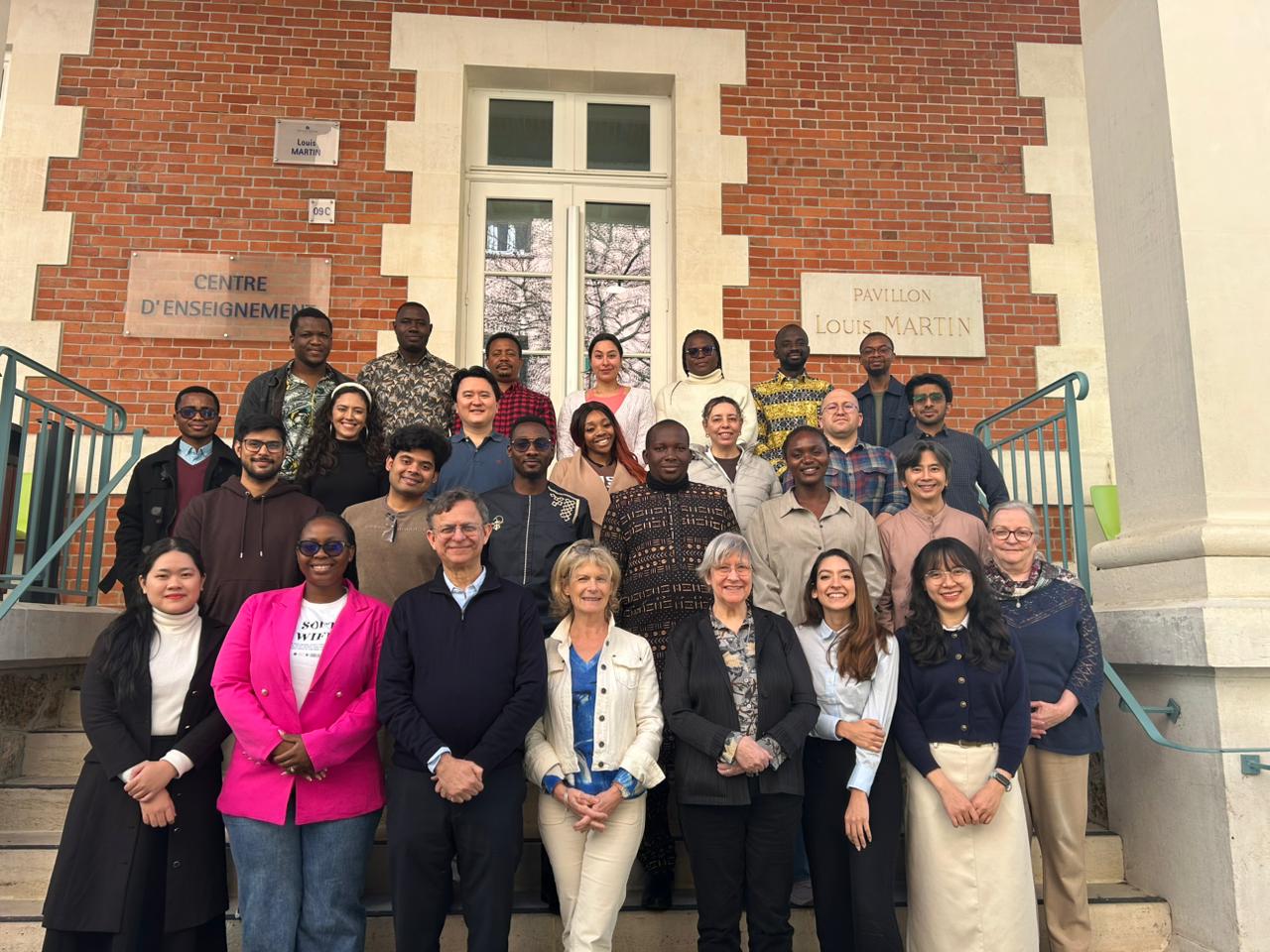
An international course brought together scientists, physicians, and representatives of global organizations to discuss not only vaccine development, but also the real-world challenges of implementing vaccines worldwide.
“It wasn’t a course about vaccines in the way we usually see — just immunology and technology. It was about how a vaccine actually reaches people.” This is the perspective of doctoral researcher Raquel de Oliveira Souza, from the Genomic Surveillance and Vaccine Innovation group at the Institut Pasteur of São Paulo (IPSP), who spent a month in Paris attending the Institut Pasteur Vaccinology Course, from February 16 to March 13, 2026, with a Calmette & Yersin fellowship from the Institut Pasteur.
Throughout the program, which brought together participants from different countries and fields — from basic research to roles in international organizations — one of its main distinguishing features, according to Raquel, was its broadened approach to vaccinology, incorporating social, political, and logistical dimensions that are often underexplored in scientific training.
“The course shows that there is a gap between developing a vaccine and actually administering it to humans. Many candidates remain in that limbo. There, we discussed exactly how to bridge that gap,” she explains.
From the laboratory to the real world – The course was structured as a full immersion into the vaccine development pipeline. Across three modules, participants covered everything from fundamentals such as epidemiology, transmission modeling, and immune response, to advanced stages including antigen discovery, vaccine platforms, clinical trials, and manufacturing under good manufacturing practices. Topics such as distribution logistics, global access, vaccine economics, and vaccine hesitancy were also addressed.
In practice, one of the aspects that most stood out to the researcher was exposure to different realities of vaccine implementation.
According to her, this broadened her understanding of how vaccination occurs in diverse contexts. “Talking to people working in Africa, for example, completely changes your perception of access, adherence, and vaccination strategies,” she says.
Training with global stakeholders – The course featured speakers affiliated with institutions such as WHO, CEPI, Sanofi, Imperial College, Baylor College of Medicine, Takeda, AstraZeneca, Pfizer, PATH, and the Gates Foundation, as well as researchers from the Institut Pasteur itself.
In addition to lectures, participants were divided into groups to develop complete vaccine proposals, from antigen selection to clinical trial design and definition of target populations. “We had to make real decisions: where to test, which population to choose, what criteria to use to move forward or halt development. That brings you much closer to reality,” she notes.
Networks, strategy, and tools – Another central aspect of the experience was building international networks — something that, according to the researcher, is crucial for advancing projects.
“You learn that developing vaccines is not just about science. It’s about knowing who to reach out to, how to structure a project, and how to connect different fields. Without that, the vaccine doesn’t move forward.”
Originally from Rio de Janeiro, Raquel de Oliveira Souza holds a degree in Biological Sciences from the Federal Fluminense University (UFF). She began her career at IPSP as a technical training fellow and, after completing a master’s degree in Parasitology at the Institute of Biomedical Sciences of the University of São Paulo (USP), returned to the institution for her PhD.
She currently conducts research on seasonal influenza vaccines, including H1N1 and H3N2, under the supervision of researcher Rubens Alves, within the USP Biotechnology program.