
At the International Symposium on Innate Immunity, researchers discussed mechanisms used by Mycobacterium tuberculosis to survive within the host, a strategy to improve vaccine performance through recombinant BCG, and ways to limit the damage caused by excessive inflammatory responses.
Understanding how the tuberculosis bacterium survives in the body, developing vaccination strategies capable of broadening and prolonging protection, and preventing the immune response itself from damaging tissues: these three challenges were at the heart of the first scientific presentations at the International Symposium on Innate Immunity, held on September 4 and 5 at the University of São Paulo and organized by the University of São Paulo’s Institute of Biomedical Sciences (ICB-USP) and the Institut Pasteur de São Paulo (IPSP).
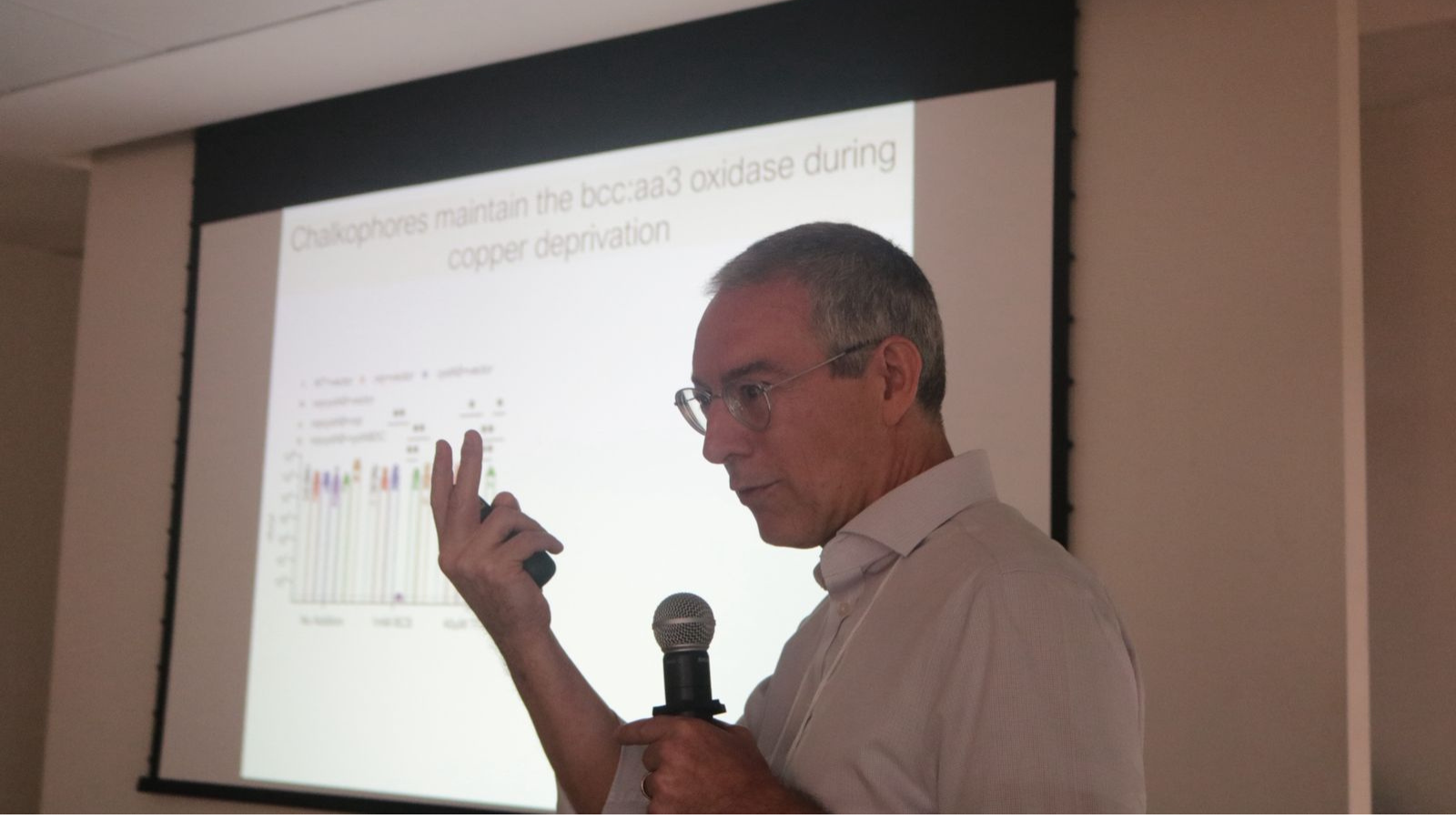
The three talks presented different aspects of the interaction between Mycobacterium tuberculosis and the host. Michael S. Glickman described a mechanism used by the bacterium to obtain copper and sustain respiration during infection. Luciana C. C. Leite presented results from a recombinant BCG vaccine developed to enhance protection against tuberculosis. Regina D’Império Lima, in turn, discussed how excessive activation of inflammatory pathways can aggravate tissue damage and how this process could become a target for therapeutic strategies.
How the bacterium secures the copper it needs
In the first presentation, Michael S. Glickman, from Memorial Sloan Kettering Cancer Center in the United States, discussed a mechanism used by M. tuberculosis to survive under adverse conditions within the body. Upon reaching the lungs, the bacterium lives mainly inside macrophages, where it faces different forms of stress imposed by the host.
One of these is known as nutritional immunity, a mechanism through which the body alters the availability of nutrients and metals that are essential to the pathogen. Glickman showed that this struggle does not involve metal intoxication alone: under certain conditions, the bacterium must also respond to metal scarcity.
The researcher focused his presentation on copper. His group studied a set of M. tuberculosis genes activated under conditions of copper deprivation. These genes are involved in the production of small molecules with an extremely high affinity for copper, known as chalkophores, which are capable of capturing it when it becomes scarce.
The experiments indicated that this system has a very specific function: supplying copper to the bacterial respiratory chain, particularly to the bcc:aa3 oxidase. “This chalkophore system is acquiring copper to sustain bacterial respiration. It is essentially a system dedicated to copper acquisition for the bcc:aa3 oxidase,” Glickman explained.
The research reveals a competition for nutrients between the host and the pathogen. While the body restricts nutrients required by the bacterium, M. tuberculosis has mechanisms to recover them and preserve essential functions. Glickman also linked these findings to the mycobacterial respiratory chain, an area that has been explored as a target for the development of new tuberculosis drugs.
A recombinant BCG vaccine to enhance protection
The second talk was presented by Luciana C. C. Leite, from the Vaccine Development Laboratory at the Butantan Institute’s Biotechnology Center. She began with a central challenge in tuberculosis control: despite the availability of BCG and treatments for the disease, the vaccine provides limited protection against pulmonary tuberculosis in adults, and the available treatment regimens are lengthy. Another challenge is the lack of clearly defined correlates of protection—that is, it remains unclear exactly which characteristics of the immune response provide protection against the disease.
The Butantan group is working with a recombinant BCG vaccine genetically modified to express a detoxified derivative of a bacterial toxin that functions as an adjuvant. In the experimental models presented, this recombinant version provided greater protection than conventional BCG and reduced the pathology observed after infection.
The duration of the response was also a central point. “In addition to improving protection, we want it to last longer,” she said. In the experiments, recombinant BCG induced an early response and maintained higher levels of memory-associated immune responses for longer periods, whereas the protection observed with conventional BCG began to decline.
To investigate the mechanisms responsible for this difference, the researchers used transcriptomics and systems biology. The analyses showed that the recombinant vaccine did not appear simply to produce a stronger response of the same type: it activated different sets of genes from those observed with conventional BCG.
Among the mechanisms that drew the group’s attention were autophagy and the regulation of circadian genes. The data presented by Luciana Leite indicated greater activation of markers associated with autophagy, a cellular degradation and recycling process that also plays a role in defense against intracellular microorganisms. The transcriptomic analyses also revealed changes in pathways related to circadian regulation, suggesting that these mechanisms may contribute to the protection observed.
The researcher also presented preliminary results obtained with human cells and humanized mice. In the latter model, recombinant BCG once again provided greater protection than conventional BCG. According to the researcher, these results support the continued development of the strategy toward studies aimed at human applications. At the end of the presentation, she also discussed a One Health perspective, integrating the development of human and veterinary vaccines against tuberculosis.
When the immune response begins to cause damage
The third presentation shifted the focus to another aspect of severe infections: the balance between an immune response necessary to control the infectious agent and inflammation intense enough to damage the body’s own tissues. Regina D’Império Lima, from the Department of Immunology at ICB-USP, presented studies on the ATP–P2RX7 axis as a potential target for tissue-protection strategies.
“The immune response is very important for controlling the disease. But if it is too strong, it can also cause a major inflammatory response and tissue damage,” Regina Lima explained. This problem is particularly relevant in organs such as the lungs and brain, where extensive lesions can impair essential functions.
One of the signals associated with this process is extracellular ATP. Normally found at high concentrations inside cells, ATP is released when tissue damage occurs. At high concentrations outside cells, it activates the P2RX7 receptor, which acts as a damage sensor and can trigger inflammatory activation and cell death.
In the tuberculosis models presented, P2RX7 activation was associated with the death of infected macrophages, the formation of necrotic lesions, and inflammation. The experiments also showed that CD4 T cells, although essential for controlling infection, can contribute to immunopathology when they accumulate in large numbers in lung tissue.
The researcher also demonstrated the role of CD39, an enzyme capable of breaking down extracellular ATP and thereby reducing P2RX7 activation. Animals lacking CD39 developed more severe necrotic lesions. When P2RX7 was pharmacologically inhibited, the disease became less severe and the lesions were reduced, reinforcing the hypothesis that this pathway could be explored to limit tissue damage.