
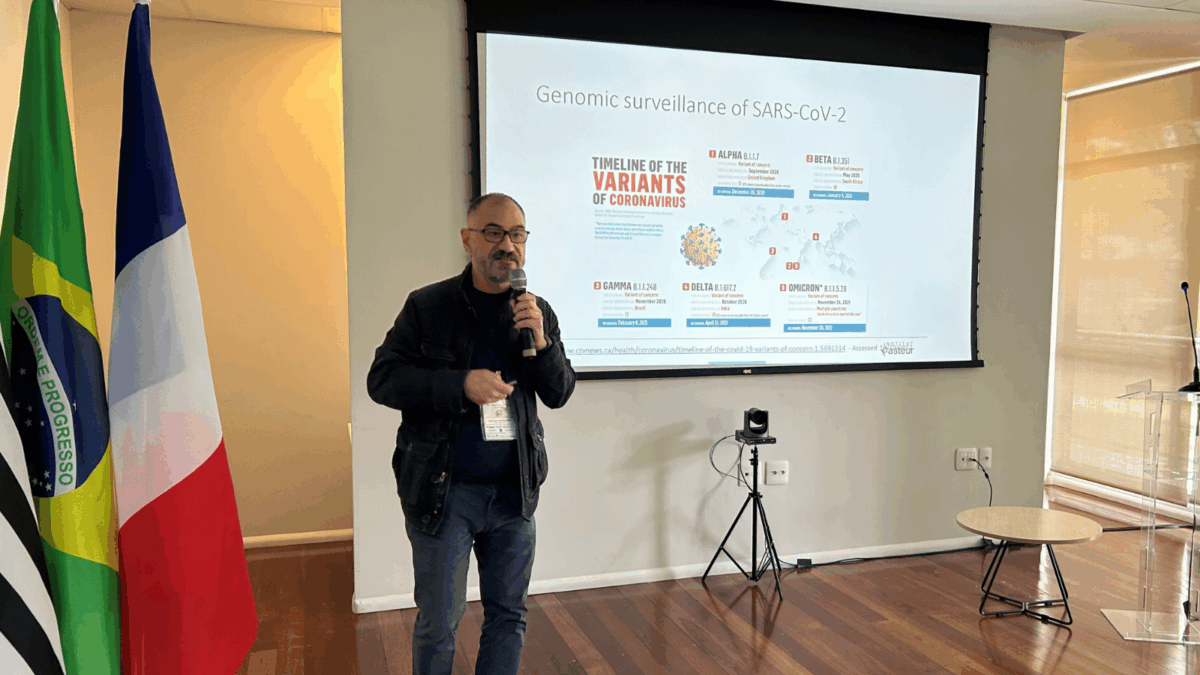
At an international forum, researchers from the Pasteur ecosystem demonstrated how genomics, biodiversity, and integrated surveillance are transforming the way epidemics are anticipated.
Science is entering a new era: it is now possible to detect viruses in the environment before they cause disease in humans. This paradigm shift, driven by the genomic revolution and the rapid evolution of sequencing technologies, was one of the central themes of the panel Biodiversity, Surveillance & Pathogen Discovery, held on October 20th during the international forum “Global Health in Tropical Regions: Perspectives from Latin America and West Africa in a Changing World – French Contributions”, organized by the Institut Pasteur de São Paulo (IPSP).
Virologist Jean-Claude Manuguerra, from the Institut Pasteur de Paris, noted that identifying a virus — a process that once could take years, as in the case of hepatitis C — can now be done within days. “What has changed is that we now have tools that allow us to detect the presence of viruses long before they cause disease,” he explained. Using metagenomics and next-generation sequencing, scientists can analyze environmental samples — of water, air, or surfaces — and detect viral fragments even when no clinical cases have yet been reported.
“We are moving from merely reacting to outbreaks to anticipating what might happen. It is a new paradigm because we can now see what was once invisible,” he said. For Manuguerra, this represents not only a technological leap but also a cultural shift in science, which increasingly views the environment itself as a reservoir of information about viruses, rather than focusing exclusively on infected patients.
Domestic animals as health sentinels
Building on this integrated perspective of human, animal, and environmental health — the One Health approach — Ghislaine Prévot, from the Université de Guyane, demonstrated how domestic animals can serve as biological sentinels for the early detection of zoonoses in tropical regions, where deforestation and climate change bring humans and wildlife into closer contact. Her team studies pathogens such as Leishmania, Trypanosoma, Leptospira, Toxoplasma, and Anaplasma in dogs and cats, correlating infections with environmental data — vegetation type, mining activity, and population density — to predict outbreaks before they reach human communities. The analyses have already identified Leishmania strains genetically distinct from those previously known in South America.
Mosquitoes and the hidden role of vertical transmission
Entomologist Anubis Vega-Rua, from the Institut Pasteur de Guadeloupe, presented findings revealing differences in vector competence among Aedes aegypti populations across Caribbean islands. Although genetically similar, the populations studied showed marked variations in their ability to transmit viruses such as dengue and chikungunya, influenced by temperature, microbiome composition, and urban density. Vega-Rua also highlighted the phenomenon of vertical transmission—when infected females pass the virus to their eggs — which allows the pathogen to persist even in the absence of human cases. “Even when there are no human infections, viruses can remain silent within mosquito populations and re-emerge when conditions become favorable,” she warned.
From the Arctic to the Amazon: long-term surveillance
In the Federative Republic of Brazil, virologist Edson Durigon, from the IPSP and the Institute of Biomedical Sciences at the Universidade de São Paulo (ICB-USP), presented results from the PREVIR Program, which has monitored influenza viruses in wild and migratory birds for nearly three decades. Sampling sites extend from the Amazon to Antarctica and have yielded significant discoveries, including the first detection of the highly pathogenic H5N1 subtype in Brazil in 2023 and the presence of variants such as H6N1 and H6N8 in Antarctic birds.
Researcher Angélica Cristine de Almeida Campos, also from the IPSP, who studies Influenza A, reminded that aquatic birds are the virus’s main natural reservoirs. However, it can also infect mammals such as bats, horses, seals, cats, and even camels — broadening opportunities for genetic recombination and reinforcing the importance of continuous surveillance.
Technology and community in the African response
Researcher Amadou Alpha Sow, from the Institut Pasteur de Dakar, stressed the importance of engaging directly with communities. He presented a model of integrated community surveillance that connects hospitals, regional laboratories, and local health agents equipped with tablets and mobile applications, reducing response times to dengue, chikungunya, and hemorrhagic fever outbreaks from several days to less than 48 hours.
“You cannot fight a health crisis by waiting for it to happen. It is essential to connect human, animal, and environmental surveillance to act before the threat becomes visible,” he said. Supported by the World Health Organization (WHO), the Gates Foundation, and the Africa Centres for Diseases Control and Prevention (Africa CDC), the system is already being implemented in 12 West African countries, consolidating the One Health approach on a continental scale.