
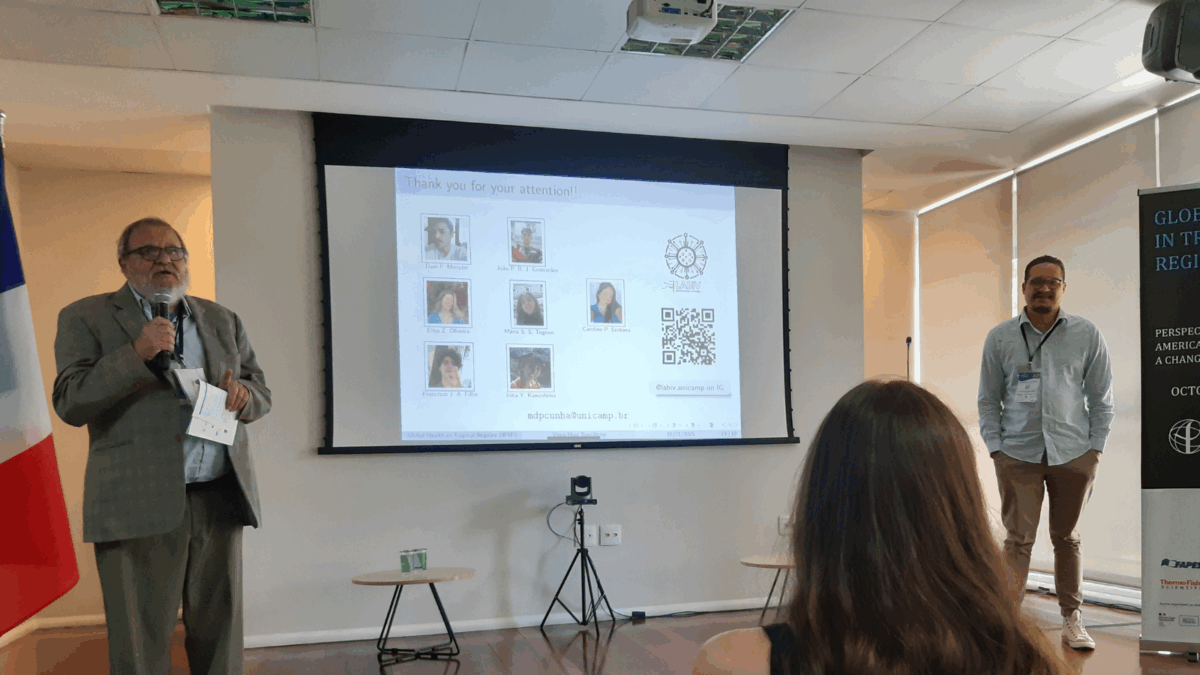
Researchers from the Pasteur ecosystem, the Institut Pasteur de Paris, and the Universidade Estadual de Campinas (Unicamp) presented innovative methods combining genomics, ecology, environmental surveillance, and data modeling to detect viruses and bacteria in different ecosystems at an international forum panel.
In the field of global health, the ability to identify pathogens quickly can be the difference between containing a threat and allowing it to spread. This idea permeated the panel Genomics, Serology & Ecosystem Surveillance, held on October 21st during the international forum ‘Global Health in Tropical Regions: Perspectives from Latin America and West Africa in a Changing World – French Contributions’, promoted by the Institut Pasteur de São Paulo (IPSP)
The session showed how science is refining ways to track viruses and bacteria from the environment—from bats in the Atlantic Forest to urban waste and sewage systems in French Guiana.
Bats in viral surveillance – IPSP researcher Luiz Gustavo Góes highlighted the role of bats as natural reservoirs of viruses with the potential to jump between species. His group collects samples in caves, forests, and urban areas. Their aim is to combine phylogenetic analysis and genetic sequencing to map viruses poorly understood up to now.
“Bats are essential for pollination and ecological balance, but they also harbor enormous viral diversity. Understanding this dynamic is essential for assessing the risks of transmission to humans,” he explained. This word identified genetic fragments of coronaviruses, paramyxoviruses, and arenaviruses, some of which are close to strains that cause diseases known as MERS and Nipah.
Bacteria under the scrutiny of genomics – Microbiologist Carolina Silva Nodari, from the Institut Pasteur de Paris, presented a different perspective: the advance of antimicrobial resistance. Her group uses genomic tools and historical databases to understand how pathogenic bacteria evolve and become more resistant.
“Diarrhoeal diseases still kill more than one million people a year, mainly children, and the lack of adequate surveillance accelerates the problem,” she said. The team develops low-cost molecular typing methods based on genetic markers to help countries with limited infrastructure quickly identify resistant bacterial strains.
Mosquitoes as biological sensors – From the Institut Pasteur in the Republic of Cameroon, researcher Ngu Abanda presented an ingenious approach to arbovirus surveillance, using automatic traps to capture mosquitoes and analyze samples for viruses such as dengue, yellow fever and chikungunya. The system employs FTA cards impregnated with sugar, which the insects consume. The material retains traces of viral RNA, allowing direct molecular testing in the laboratory.
“Our goal is to understand what is circulating silently in communities, even before cases reach hospitals,” said Abanda. The traps operate automatically from 3 p.m. to 10 a.m., the period when mosquitoes are most active. Therefore, the strategy also aims to detect asymptomatic infections that traditional surveillance systems do not capture. The technique is seen as a cost-effective and scalable solution, adaptable to countries with limited resources.
Sewage as a mirror of public health – Researcher Stéphanie Raffestin, from the Institut Pasteur de la Guyane, presented from French Guiana the results of a study on wastewater-based epidemiology (WBE) — which allows the detection of circulating pathogens from wastewater samples — a methodology also applied by IPSP in relation to the influenza virus.
In 2024, the team identified three polioviruses derived from the oral vaccine — variants that evolve from the weakened virus used in immunization when vaccination coverage is low — in sewage treatment plants, a finding that led local authorities to step up vaccination campaigns. “Sewage monitoring is a complementary tool to clinical surveillance, capable of revealing what health systems do not see: asymptomatic infections or hard-to-reach populations,” he explained. The laboratory is now expanding the method to monitor respiratory viruses, such as influenza and SARS-CoV-2, in collaboration with the WHO and European networks.
With Luminex MagPix technology, it is possible to detect up to 50 different antibodies in a single sample, allowing spatial maps of infection to be constructed and areas where multiple diseases coexist, such as malaria, schistosomiasis, and chlamydia, to be identified. “These patterns can help health authorities target resources and prevention strategies more accurately,” he said.
Genetic modelling for viral risks – In closing the session, researcher Marielton dos Passos Cunha, from Unicamp, presented a computational model that combines viral genome analysis and machine learning to predict host specificity and the zoonotic potential of new viruses. His group develops metrics based on the use of codons and genetic patterns, capable of estimating which species are most likely to harbor a given virus — strategic information for anticipating risks of spillover between animals and humans.
“The idea is to use computational biology to understand, based on genetic sequencing, whether a new virus can adapt to human cells or other hosts,” he explained. Studies on SARS-CoV-2, influenza, yellow fever, and rabies viruses already applies the method, which is being refined to identify potential transmission routes in complex ecosystems.
Mapping infections with multiplex serology – Camille Lambert, from the Institut Pasteur de Paris, French Republic, presented a serological platform capable of measuring communities’ exposure to dozens of pathogens simultaneously, using just a drop of blood. The study was conducted in two cities in the North of the Republic of Cameroon (Pitoa and Adumri), with 1,057 samples analyzed for 25 different antigens.
With Luminex MagPix technology, it is possible to detect up to 50 different antibodies in a single sample, allowing spatial maps of infection to be constructed and to identify areas where multiple diseases coexist, such as malaria, schistosomiasis, and chlamydia.
Genetic modelling for viral risks – In closing the session, researcher Marielton dos Passos Cunha, from Unicamp, presented a computational model that combines viral genome analysis and machine learning to predict host specificity and the zoonotic potential of new viruses. His group develops metrics based on the use of codons and genetic patterns, capable of estimating which species are most likely to harbor a given virus — strategic information for anticipating risks of spillover between animals and humans.
“The idea is to use computational biology to understand, based on genetic sequencing, whether a new virus can adapt to human cells or other hosts,” he explained. Studies on SARS-CoV-2, influenza, yellow fever, and rabies viruses already apply this method, which is being refined to identify potential transmission routes in complex ecosystems already apply this method.