
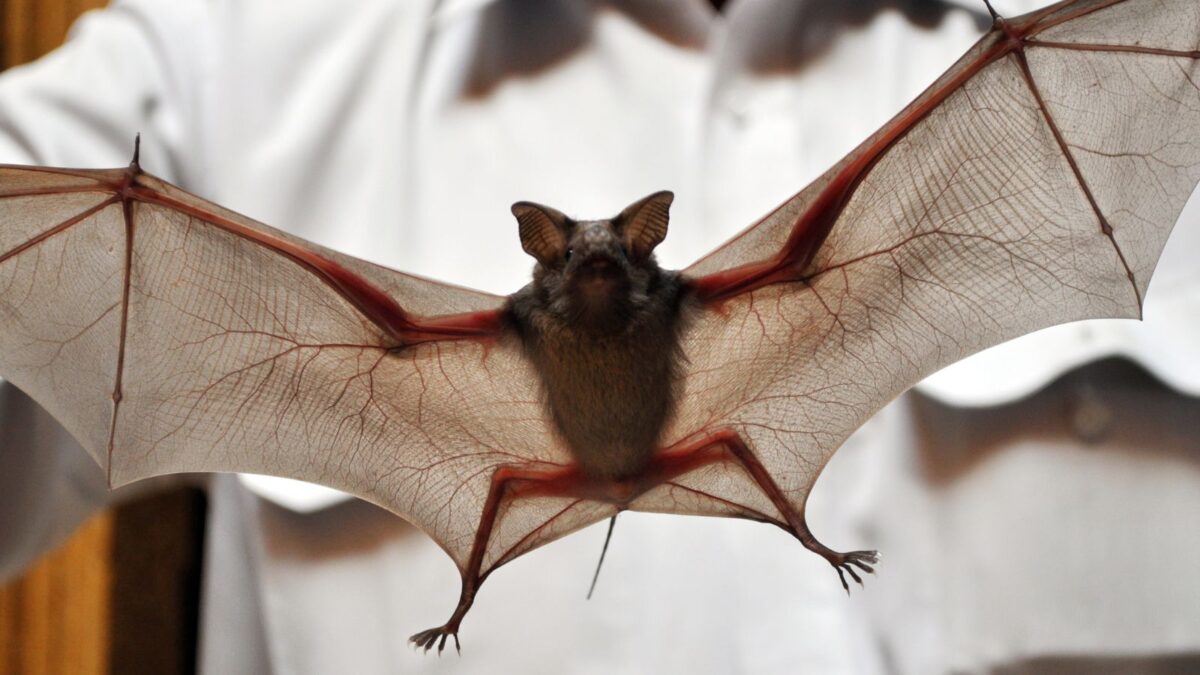
The paper, featured on the cover of Nature Microbiology, involved 14 years of research and included Brazilian researchers
A team of researchers from Latin America and Europe achieved an unprecedented feat in international virology: for the first time, they isolated and cultivated in the laboratory viruses from the genus Morbillivirus, found in Latin America. The research was conducted for more than 14 years and the paper featured on the cover of June’s issue of Nature Microbiology—one of the world’s most important journals in the field.
The research involved a broad network of institutions and included researchers such as Angélica Campos and Luiz Gustavo Góes, who now work at the Pasteur Institute de São Paulo (IPSP). Both conducted their research during a period of collaboration at Charité – Universitätsmedizin Berlin, one of the largest and most renowned medical schools in Europe, which also houses the Charité University Hospital in Berlin. The work was led by Professor Felix Drexler, zoonotic and emerging virus specialist from the Institut für Virologie (Charité Institute of Virology).
Measles’ relative – The isolated virus belongs to the same group of human measles (Measles virus) and other high-impact pathogens, considered to be some of the most contagious viruses among mammals. Although researchers had already detected genetic signs of the morbillivirus in bats, the microorganism had not been isolated from clinical samples, which limited studies on its biology, transmission risk, and zoonotic potential.
“It took years of hard work to obtain a cell line that expressed the correct receptors for the virus. My goal was to understand which receptors are involved and develop techniques to cultivate the virus in the laboratory,” emphasizes Angélica Campos, third author of the article and a researcher at IPSP. “The work was intense, involving genetic engineering, implementation of primary bat cell lines, protein expression testing, and functional validation. This was possible because we brought together an international team of researchers with very specific expertise. It’s an example of collaborative science in practice,” adds Luiz Gustavo Góes, also an IPSP researcher and co-author of the study.
Analyzing Diversity – The study analyzed more than 1,600 bats of different species from Brazil and Costa Rica, including vampire, insectivorous, and fruit-eating bats. Antibodies against the new morbillivirus were found in more than a third of the vampire bats, indicating that the infection is common and generally non-lethal in that species. The project began in 2010, with bats collected in Salvador, Iguaçu National Park, and different regions of Costa Rica. The team performed complete genetic sequencing of dozens of samples until we identified a complete viral lineage. The next—and decisive—step was to understand how the virus interacted with host cells.
Since bats morbillivirus does not use the same cellular receptors as measles (SLAMF1 and Nectin-4), we had to develop specific cell lines derived from bat tissue and test the expression of specialized cellular receptors that would enable viral replication. This technical advancement, which involved genetic engineering and functional testing, was led by Angélica Campos at the Charité Institute of Virology, with the collaboration of Luiz Gustavo Góes.
Once we finally isolated the virus and replicated it in culture, the team performed detailed phylogenetic analyses, revealing that the new virus occupies a basal position within the Morbillivirus genus—that is, it is evolutionarily closer to the common ancestor than to modern lineages, such as measles. This offers important clues about the origin and evolution of these pathogens.
Furthermore, the authors identified morbilliviruses in dead wild monkeys (marmosets) found in Brazil. Although it is unknown whether the viruses caused the deaths, genetic analyses revealed a strong similarity to bat morbilliviruses. In this case, the primate viruses used the same SLAMF1 receptor as human measles, which indicates a potential risk of interspecies transmission.
On the other hand, neutralization tests showed that antibodies generated by previous measles or canine distemper infections were effective against bat morbilliviruses, suggesting cross-immunity is possible.
Potential risk – Although tests have shown that the virus does not readily infect human cells, it is functionally and theoretically capable of doing so, especially in environments where it contacts other viruses, which increases the risk of recombination. Bats are natural hosts of several pathogens and live in close proximity to domestic animals and humans, therefore the emergence of variants with pandemic risk cannot be ruled out.
“Bat morbilliviruses does not pose an immediate threat to humans. But the lack of experimental models to study them was a serious problem. Now we can investigate their biology and better prepare for future risks,” emphasizes Angélica.
The research also highlights the importance of Latin American science in the surveillance of emerging viruses. Areas where bats are collected —with high biodiversity and increasing environmental degradation—are considered critical zones for spillover events, when a virus is transmitted from its natural host to new species, including humans. “Habitat fragmentation brings together species that previously did not interact, enabling the emergence of new viruses,” warns Angélica.
Evolutionary analyses indicate that transmission between species, such as from bats to pigs and monkeys, have occurred several times throughout the evolutionary history of morbilliviruses. Data obtained in the study reinforce the hypothesis that bats are key species in the spread of morbilliviruses to different mammalian species. This ability to switch hosts reinforces the urgency of strengthening viral surveillance in high biodiversity areas.
International recognition – The discovery’s impact was recognized by the journal Nature Microbiology, which published an editorial emphasizing how studies like this are crucial for the implementation of the new Pandemic Agreement, approved by the World Health Organization (WHO) in 2025. The editorial advocates for strengthening collaborative science, the One Health approach (which integrates human, animal, and environmental health), and investment in viral surveillance as the basis for preventing future pandemics.
The study aligns with the research currently being conducted by Luiz Gustavo Góes at the IPSP, focused on the surveillance of zoonotic viruses and the development of experimental systems adapted to local biodiversity. According to him, the work at Charité showed that detecting viral fragments is not enough—specific tools must be created to understand its complete cycle. “One of the biggest challenges was that conventional cellular systems did not work. We had to rebuild, step by step, a cellular environment that mimicked the virus natural host. Only then we were able to induce its replication. This completely changes the way we think about studying emerging viruses, specially in tropical regions like Brazil, where viral diversity is still not well known,” he explains. Access the full article at https://www.nature.com/articles/s41564-025-02005-8
Authors and institutions involved – The article was written by an international team led by Wendy K. Jo (first author, Charité – Universitätsmedizin Berlin) and Jan Felix Drexler (senior author, Charité and German Center for Infection Research – DZIF), with the participation of scientists from the Federal University of Bahia (UFBA), the Institute of Biomedical Sciences of the University of São Paulo (USP), the University of Costa Rica (UCR), the University of Glasgow (United Kingdom), the Friedrich-Loeffler Institute (Germany), and other institutions in Latin America and Europe. The research was funded by agencies such as São Paulo Research Foundation (FAPESP), National Council for Scientific and Technological Development (CNPq), German Research Foundation (DFG), DZIF, as well as other international science funding entities.