International training provided knowledge that may support the development of the high-throughput screening platform currently being implemented at the Institut Pasteur de São Paulo.
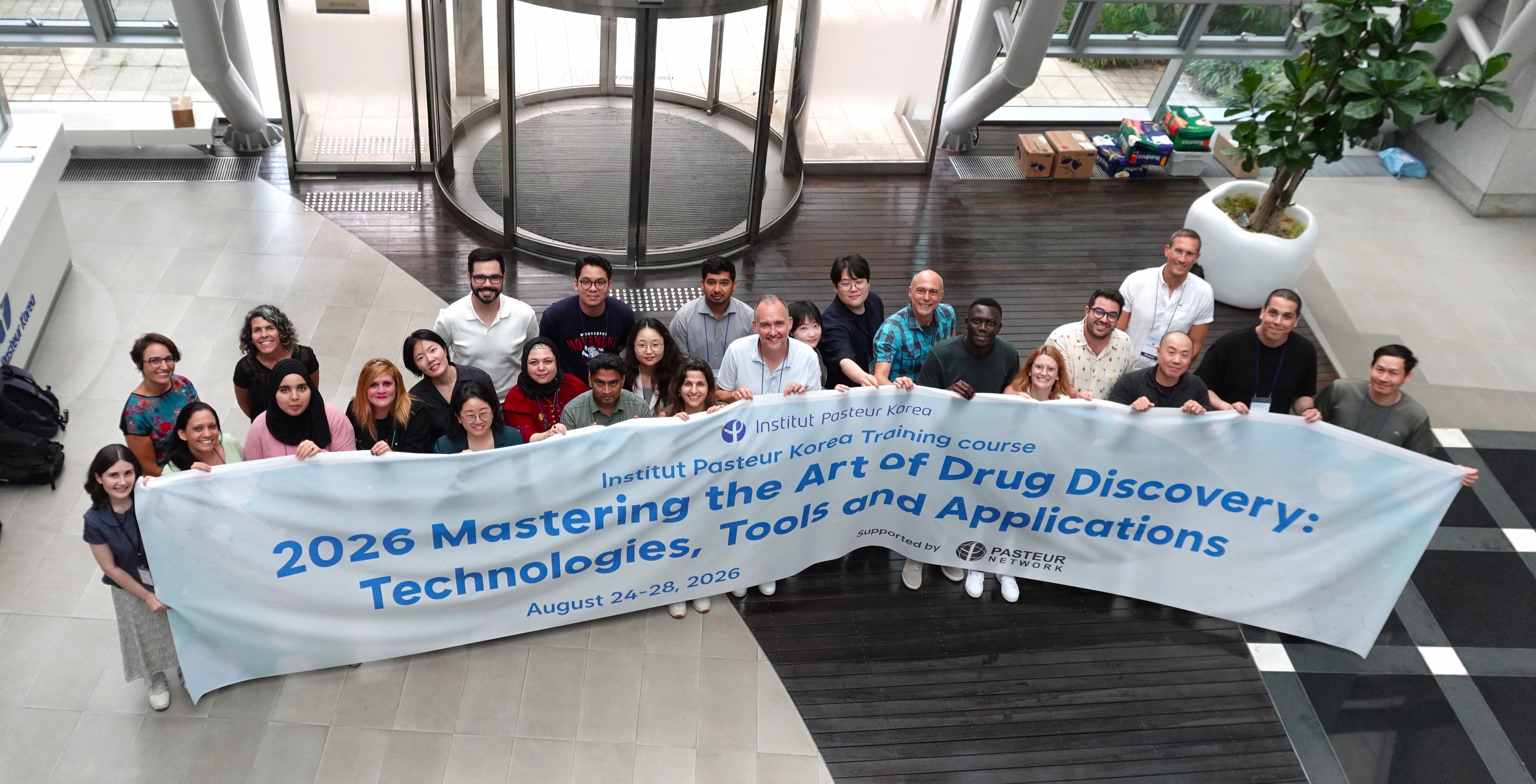
Caio Haddad Franco, a researcher at the Institut Pasteur de São Paulo (IPSP), took part in the course Mastering the Art of Drug Discovery: Technologies, Tools and Applications, held from August 24 to 28 by Institut Pasteur Korea in Gyeonggi-do, South Korea. The training covered different stages of the drug discovery process, combining theoretical classes, hands-on laboratory activities, case studies and group projects.
Selected as a participant from the Pasteur Network, Franco was among the 20 attendees, who included advanced students and experienced researchers from different countries. The program covered topics ranging from cell-based assay development and target identification to high-content screening, automation, image analysis, compound library management, and the use of bioinformatics, cheminformatics and artificial intelligence in the discovery of molecules with therapeutic potential.
The training is directly related to the platform that Franco is currently implementing at IPSP. His group has established an image-based high-throughput screening system to test compounds capable of interfering with intracellular infection by Staphylococcus aureus. Rather than acting solely on the bacterium, the strategy seeks to identify molecules that can also modulate human cell processes exploited by the pathogen to invade, survive and persist in the body. In addition to assays against S. aureus, the researcher expects to soon expand the platform to test other bacterial infection models, including clinically relevant Gram-negative bacteria such as Shigella flexneri and Salmonella.
Automated microscopy and cell profiling
Among the topics most relevant to his work at IPSP, Franco highlights the opportunity to work with advanced automated microscopy systems. These instruments acquire thousands of images of cells subjected to different treatments. The resulting analyses make it possible to compare observed phenotypes and identify which compounds produced the desired effects.
“We had access to state-of-the-art, high-resolution microscopes, including a system specifically designed for infectious disease research that I had not seen before. It was not just a theoretical presentation: we used the equipment, followed the image acquisition process and worked on the analysis of the results,” he says.
The course also introduced participants to Cell Painting, a morphological profiling technique that uses fluorescent markers to reveal different cellular structures. Multiparametric image analysis can identify changes caused by compounds and provide clues about their effects and potential mechanisms of action. This is one of the methodologies Franco plans to establish within IPSP’s new platform.
From compound management to test automation
Another important area of learning involved compound library management. Institut Pasteur Korea maintains a collection of more than 500,000 molecules, including commercially acquired compounds and others synthesized by the institution itself. Participants learned about procedures for identifying, storing, curating, preparing and tracking these libraries, as well as automated liquid-handling systems and microplate preparation.
This knowledge will be useful as IPSP expands its storage capacity and develops its own compound library. “When a collection is small, it can be managed relatively simply. As it grows, however, it becomes essential to organize inventory, usage history, plate preparation, replica generation and sample distribution for testing. I wanted to better understand how a large-scale platform manages all of this,” Franco explains.
The researcher also learned about a South Korean repository of biomolecules and compounds made available to the scientific community. The resource may be explored in the search for molecules of interest to projects conducted in São Paulo, subject to the necessary application and shipping procedures.
Connections within the Pasteur Network
In addition to providing technical updates, the training opened up opportunities for collaboration. Franco established contacts with researchers working in screening and drug discovery and discussed possibilities for exchanging technologies and compound libraries. There is shared interest, for example, in developing assays focused on bacterial infections, an area in which the institutes’ platforms may bring together complementary expertise.
“It was one of the most comprehensive screening courses I have ever attended. I was able to update my knowledge of technologies at the forefront of the field while also building connections that may contribute to the IPSP project,” he says.
For Franco, the experience also demonstrates how working within a network can accelerate the development of new scientific capabilities by overcoming geographical, cultural and linguistic barriers. The circulation of specialists, methods and resources among the institutes makes it possible to adapt knowledge already established at other centers to local research needs — while also creating new opportunities for international cooperation.
About the course
Mastering the Art of Drug Discovery: Technologies, Tools and Applications is an intensive course offered by Institut Pasteur Korea with support and co-funding from the Pasteur Network. The 2026 edition brought together researchers in biology, chemistry and data science and covered the path from basic research to therapeutic innovation. Half of the 20 available places were reserved for members of the Pasteur Network.