
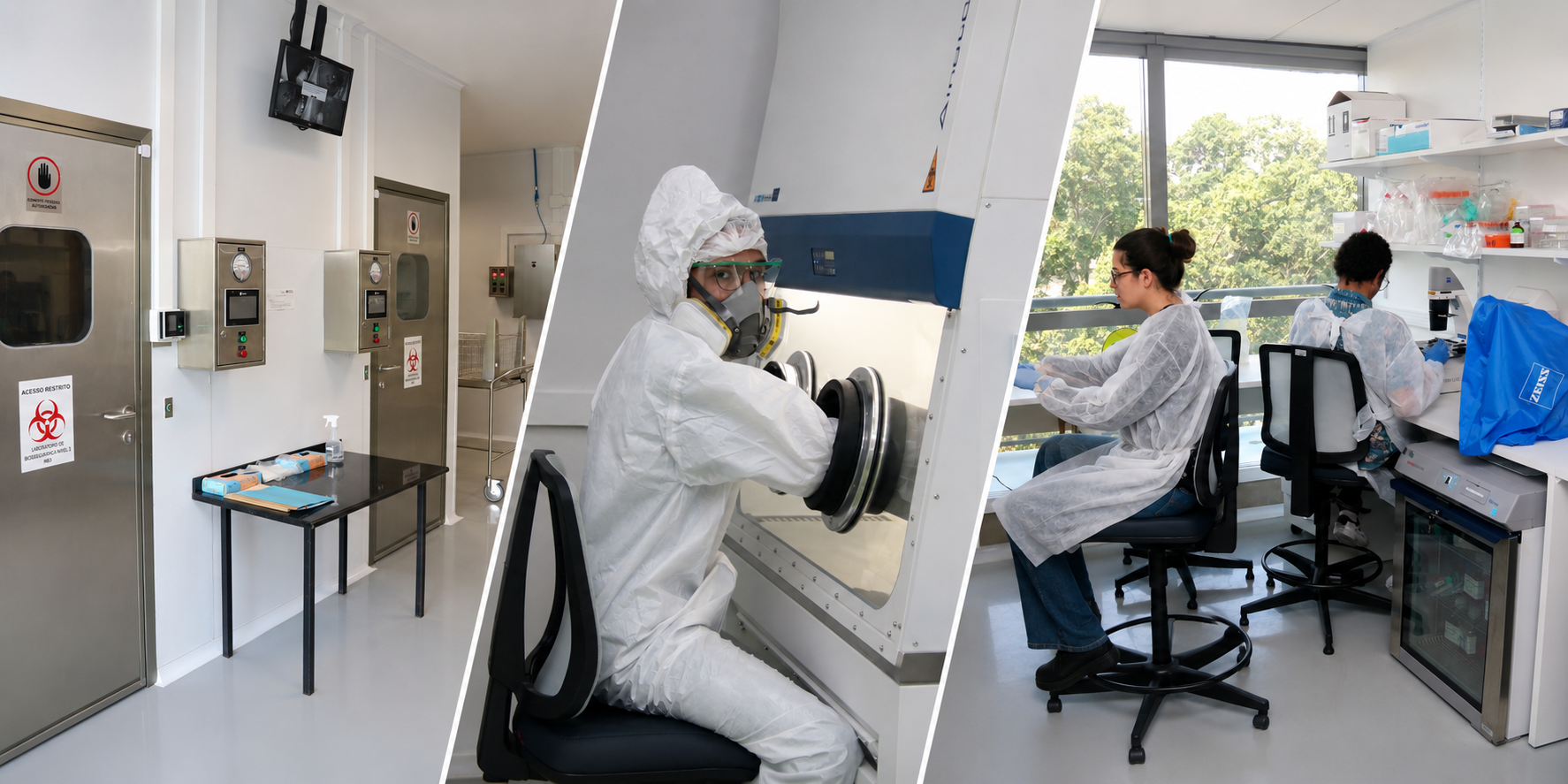
Model implemented by the Institut Pasteur of São Paulo aims to prevent the loss of experimental knowledge caused by researcher turnover and transform the institute into a permanent structure for training, standardization, and technology transfer.
In scientific institutions that are highly focused on innovation, the departure of researchers often takes away much more than names or research lines. Frequently, an invisible yet essential asset for experimental science is also lost: the practical knowledge accumulated through daily laboratory work — technical details, fine adjustments, operational procedures, and empirically developed solutions that can rarely be fully described in scientific articles.
To address this challenge, the Institut Pasteur de São Paulo (IPSP) has implemented a technical structure that is still uncommon among Brazilian research centers. The institute now has permanent professionals dedicated not only to laboratory support but also to the preservation, standardization, and transmission of the technical knowledge generated internally.
Technical memory – The first professional selected for this mission was Roberto Augusto Pereira de Sousa, a laboratory specialist affiliated with the University of São Paulo (USP), with a background in Biology, a Master’s and PhD in Immunology and Parasitology, and international experience in Canada. Chosen specifically for this strategic role within the IPSP structure, he works across the institute to monitor techniques, standardize procedures, strengthen scientific reproducibility, and preserve the experimental knowledge accumulated by all research groups.
His role was conceived as a form of institutional “technical memory.”
“The idea is that this technician does not belong to any specific researcher. He is an IPSP technician whose mission is to learn, become familiar with all the techniques developed here, implement operational procedures, and train researchers, students, and new technicians who join the institute,” explains Paola Minoprio, Executive Director of IPSP.
According to her, the model emerged from the need to address a structural challenge commonly faced by scientific institutions that depend heavily on temporary projects and research fellowships.
“The institute works with many researchers linked to temporary projects and scientific talent attraction programs. This model is extremely important for innovation, but it also creates the challenge of preserving the technical knowledge accumulated when these researchers complete their cycles at IPSP,” says Minoprio.
Living knowledge – Although scientific results are published in papers, much of the experimental knowledge remains tacit, built through researchers’ daily practice.
“One thing is reading a paper. Another is having hands-on bench experience”, explains Roberto Sousa. “An article will never be detailed enough to fully convey the refinement of a technique, the adaptations required, or the practical problems that arise during execution.”
At IPSP, the goal is precisely to prevent this knowledge from depending exclusively on the presence of a specific researcher or student. To achieve this, Sousa works across the institute’s different groups, following researchers, learning techniques, organizing documentation, standardizing operational procedures, and recording detailed experimental protocols.
Among the techniques considered priorities are sophisticated procedures such as brain organoids (mini-brains), digital PCR, and advanced genetic sequencing — methodologies still mastered by only a limited number of groups in Brazil.
Scientific expansion – Created in July 2019 as the Scientific Platform Pasteur-USP, the current Institut Pasteur of São Paulo began its activities with six research groups focused mainly on infectious diseases, immunology, virology, and neuroscience.
In March 2024, the institution was officially transformed into the Institut Pasteur de São Paulo (IPSP), consolidating a new phase of scientific expansion and internationalization. Since then, new groups have joined the institute, which now conducts research in areas such as genomic surveillance, viral spillover, One Health, climate change, urban rodent virology, and therapies against multidrug-resistant pathogens.
An important part of this growth has come through the attraction of young researchers linked to temporary projects, including the so-called G4 groups — an initiative created through an agreement between the Institut Pasteur, USP, and FAPESP to attract scientific talent to Brazil.
Research advances have also increased the international exchange of scientists interested in studying infectious diseases in a context marked by Brazil’s high biodiversity and epidemiological complexity.
Within this environment of continuous growth, internationalization, and constant researcher mobility, preserving accumulated technical knowledge has become a strategic issue to ensure the continuity of scientific activities and prevent the loss of highly specialized methodologies developed within the institute.
A strategic role – According to Roberto Sousa, his work goes beyond the traditional operational support usually found in shared-use laboratories.
“A shared laboratory technician typically assists with equipment operation. Here, the idea is different. I follow what researchers are doing, understand the objectives of their studies, and document the methodologies being developed,” he explains.
In addition to experimental documentation, he is involved in drafting and reviewing Standard Operating Procedures (SOPs), monitoring biosafety standards, managing laboratory waste, and organizing internal processes related to the institute’s scientific routine.
The structure is also supported by Marina Monti, an IPSP laboratory technician who assists mainly with general operational routines and more day-to-day laboratory procedures.
Continuous improvement – According to Minoprio, the next stage of the project is to further strengthen quality processes and good laboratory practices within the institute.
“In the future, we want to implement a robust quality and good laboratory practices structure. This requires training in management, operational organization, and standardization,” she says.
“If an important new technology emerges for the institute, this technician can be sent elsewhere to specialize and then implement that technique here,” Minoprio explains.
For the IPSP Executive Director, this approach transforms technicians into strategic agents of institutional scientific sustainability. “They become the Pasteurian memory of the institute,” she concludes.