
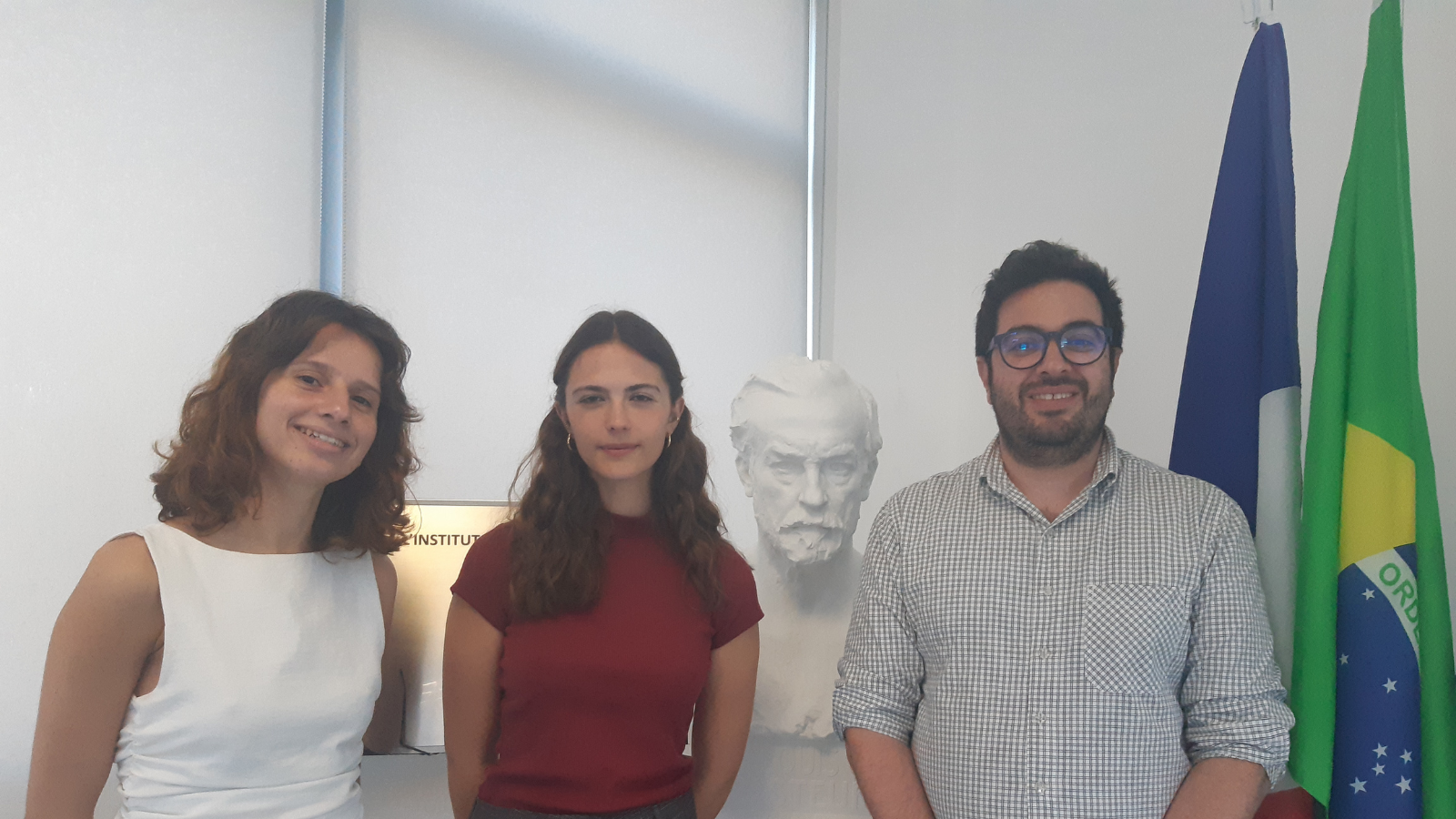
During their research internships at IPSP, students from France and Canada helped establish experimental platforms and identify compounds with therapeutic potential for the development of new treatment strategies.
Over a period of just over two months, two international students contributed to the implementation of experimental platforms that will become part of the research conducted by the Therapeutics for Combating Multidrug-Resistant Pathogens group at the Institut Pasteur de São Paulo (IPSP), led by researcher Caio Haddad Franco. Their work involved standardizing laboratory protocols, developing data analysis tools, and evaluating antibiotics and natural compounds with the potential to combat infections caused by Staphylococcus aureus, one of the leading bacterial pathogens associated with resistance to antibiotics used in clinical practice.
The activities were carried out by Manon Anglade, a student at the Institut Supérieur d’Ingénieurs de Franche-Comté (France), and Lola Desert, a Microbiology and Immunology student at McGill University (Canada), during research internships at IPSP.
According to Caio Haddad Franco, the students’ contributions were essential in establishing the experimental infrastructure of the newly created research group.
“They established protocols and experimental foundations that will be used by future members of the project, while also advancing the evaluation of compounds that have already shown promising results in our system,” said the researcher.
The experience also highlighted the importance of internationalization and scientific collaboration in advancing research projects.
New strategies – The students’ activities are part of the research program led by Caio Haddad Franco, which investigates new approaches to combating infections caused by Staphylococcus aureus, one of the most clinically significant bacteria and a major contributor to antimicrobial resistance.
The project combines several strategies, including the evaluation of approved drugs and natural compounds, with the goal of identifying molecules capable of acting against resistant strains and generating new therapeutic candidates. The initiative is part of a new research group established at IPSP with support from FAPESP and the Institut Pasteur in Paris.
During her internship, Manon Anglade participated in implementing and validating the protocols used for screening drugs against resistant S. aureus strains. Her work included standardizing laboratory assays, defining experimental parameters, and developing tools to automate the analysis of the large volumes of data generated during the experiments.
She also contributed to the evaluation of antibiotics and natural compounds, helping identify compounds and combinations that produced promising preliminary results and will be further investigated in future studies.
A promising compound – Lola Desert focused on implementing a high-content screening platform based on automated microscopy and image analysis to identify compounds capable of targeting bacteria that remain inside host cells—a condition that reduces the effectiveness of many conventional antibiotics. The imaging assays were conducted in collaboration with Professor Lúcio Freitas, from the Institute of Biomedical Sciences at the University of São Paulo (ICB-USP), a collaborator on the project.
Among the compounds evaluated, one displayed a distinct behavior compared with the other candidates. In the experimental images, intracellular bacteria appeared dispersed and isolated throughout the cell cytoplasm rather than forming the clusters typically associated with intracellular replication, suggesting a possible effect on this critical stage of cellular colonization.
“We still need to repeat the experiments and better understand the underlying mechanism, but this compound clearly behaved differently from the other candidates,” said Lola Desert.
International experience – Beyond their scientific contributions, the internships represented an important educational experience for both students.
For Lola Desert, it was her first experience in a research laboratory.
“I learned virtually everything from scratch, from basic laboratory techniques to designing experiments. Being involved in building this research platform is an experience that I will carry throughout my career.”
Manon Anglade emphasized both the technical training and the opportunity to work in an international research environment.
“I learned many new techniques, including cell culture, which I had never performed before. Working in another country and at a research institution such as the Institut Pasteur de São Paulo was an extremely enriching experience for my professional development.”
The results obtained during the internships were presented at a seminar held on July 3, 2026, at the Institut Pasteur de São Paulo, where researchers from the institution discussed the progress made in developing the experimental platforms and the initial stages of the research project aimed at discovering new antimicrobial compounds.