
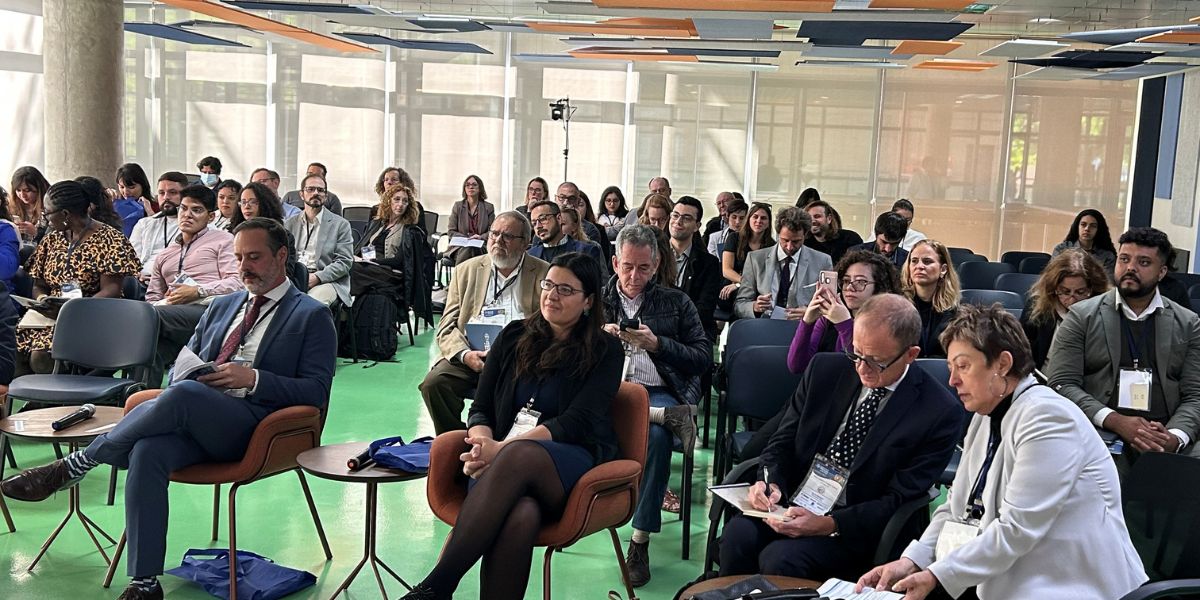
The event brought together scientists from Brazil and the Pasteur Network to discuss scientific cooperation in global health, focusing on emerging and re-emerging diseases, biodiversity, and the impacts of climate change.
The International forum Global Health in Tropical Regions: Perspectives from Latin America and West Africa in a Changing World – French Contributions began this Monday (20), bringing together representatives from France, Universidade de São Paulo (USP), and the Pasteur Network. Held at USP’s campus, the event runs until October 22 as part of the official program of the France-Brazil Season 2025, focusing on scientific cooperation as a tool to address the challenges of global health in tropical regions.
“This forum is more than a scientific event: it is a political and collective gesture toward a common future centered on health, innovation, and sustainability,” said Paola Minoprio, executive director of the Institut Pasteur de São Paulo (IPSP). She highlighted Brazil’s role as a “living laboratory”, due to its biodiversity and environmental contrasts, and recalled that the IPSP, one of the newest institutes in the Pasteur Network, has expanded partnerships with institutions such as USP, Centre National de la Recherche Scientifique (CNRS), Institute of Radiation Protection and Dosimetry (IRD), Institut National de la Santé et de la Recherche Médicale (Inserm), Fundação Oswaldo (Fiocruz), and São Paulo Research Foundation (FAPESP).
The Consul General of France in São Paulo, Alexandra Mias, emphasized that the event is one of the milestones of the France-Brazil season and reinforced the bilateral commitment to science and multilateralism. “Global health is at the heart of this cooperation. It is an area in which both countries share complementary responsibilities,” she said. She also highlighted the founding of the IPSP at USP as a symbol of the Franco-Brazilian scientific partnership.
The representative of the French Embassy in Brazil, Sophie Jacquel, stressed that health is a priority of the French scientific diplomacy and that collaboration between the two countries should be expanded. She mentioned the joint ANR–CNPq open call to fund scientific projects and the recently created Centro Franco-Brasileiro da Biodiversidade Amazônica, focused on research in the Amazon. “The IPSP shows that scientific cooperation can generate real social and environmental impact, by connecting France, Brazil and Africa around common challenges,” she said.
Speaking on behalf of the Institut Pasteur de Paris, Christophe Denfert, Director of International Relations, stressed the institution’s four historical missions: research, education, public health and innovation, and remarked that IPSP “is already included in the Pasteur constellation.” He highlighted the importance of strengthening the ties between the network’s units, especially in tropical regions, and promoting open, collaborative science committed to social responsibility. “These connections, initiated by figures such as Pedro II and Oswaldo Cruz, continue to grow and renew themselves,” he suggested.
Representing USP, the Pro-Rector of Graduate Studies, Rodrigo Calado, highlighted the social impact of this collaborative model. “This type of scientific partnership helps understand neglected diseases, rarely studied in the Global North. The IPSP demonstrates that international alliances can transform public health,” he said.
The director of the Department of Global Health at the Institut Pasteur (Paris), Hervé Bourhy, closed the institutional part of the ceremony by stressing the importance of connecting experiences from different tropical regions. “It is inspiring to see IPSP’s work put into practice the global mission of the Pasteur Institute, focused on research and the training of new generations of scientists,” he asserted.
From the Amazon to public health: science in the field and a lecture on climate
Professor Carsten Wrenger (ICB-USP/IPSP) presented the results of the Amazonian School on Global Health, a postgraduate course which provided a practical experience in the city of Montenegro (Rondônia State), based on a course developed at USP. The fieldwork activity brought together students from various countries, who collected samples that were analyzed in the IPSP laboratories. “After intensive fieldwork, the students are showing that this data can be translated into applied knowledge,” said Wrenger before the screening of a video about the Amazon expedition and the students’ presentations.
The morning session also included a presentation by researcher Mauro César Cafundó de Morais, from IPSP, who presented the lecture “Climate and Health Program,” about an international initiative of the Pasteur Network aimed at understanding the effects of climate change on vector-borne diseases, and the panel “Biodiversity, Surveillance & Pathogen Discovery,” moderated by Rúbens Alves (IPSP), with panelists Edison Durigon (USP), Ghislaine Vega Rua (Institut Pasteur de Guadaloupe), Jean Claude Manuguerra (Institut Pasteur de Paris), Abdoulaye Sow (Institut Pasteur de Dakar), and Angélica Cristine de Almeida Campos (IPSP).
In the afternoon, the forum continued with the “Junior Researchers Speed Talks” session, moderated by Carsten Wrenger, featuring 15 short presentations by young researchers. The program also included a poster exhibition and a visit to the institute’s facilities, closing the first day with an exchange of experiences between scientists from different fields and generations.