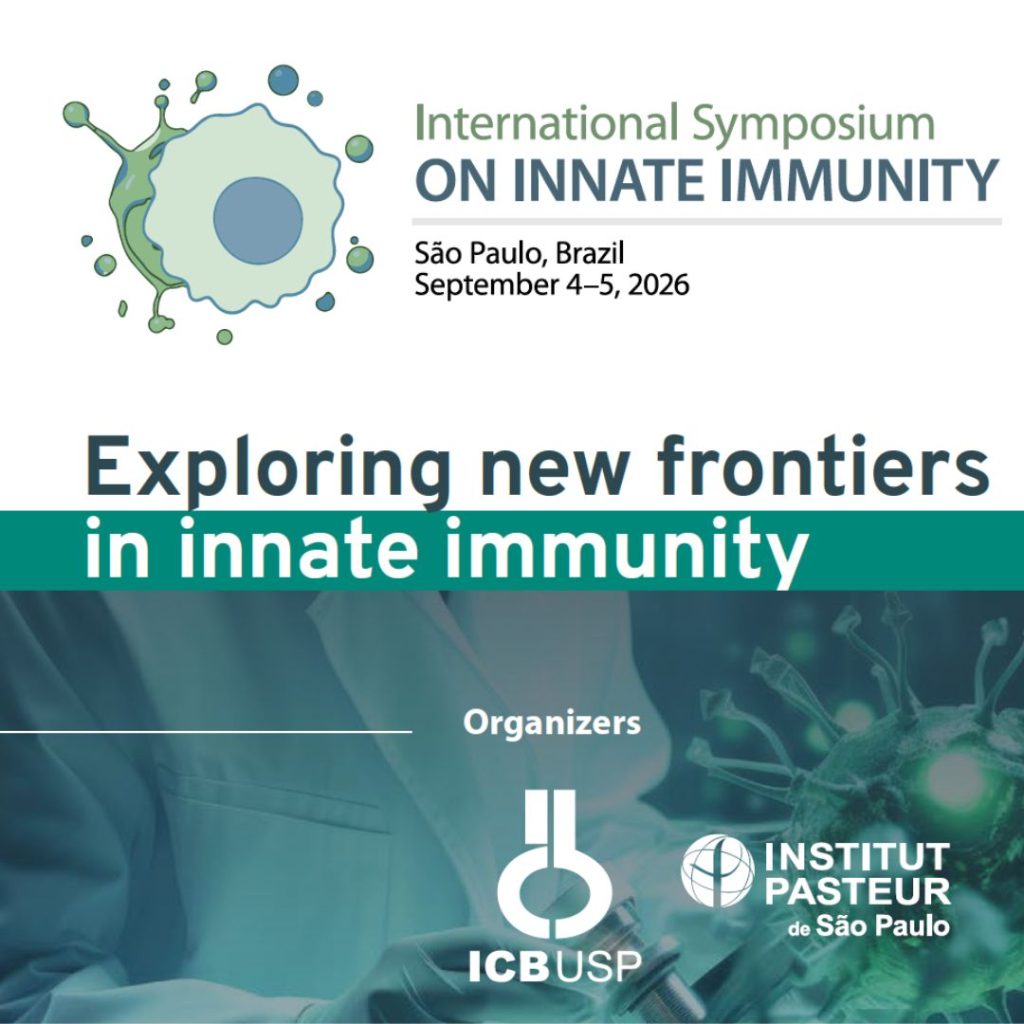
The event, organized by ICB-USP and the Institut Pasteur de São Paulo, will bring together scientists from institutions in the United States, Canada, New Zealand, Argentina and Brazil.
Researchers from some of the leading scientific institutions in Brazil and abroad will gather at the University of São Paulo (USP) on September 4 and 5 for the International Symposium on Innate Immunity. Organized by the Institute of Biomedical Sciences of the University of São Paulo (ICB-USP) and the Institut Pasteur de São Paulo (IPSP), with sponsorship from the São Paulo Research Foundation (FAPESP), the event will discuss recent advances in the study of innate immunity, with particular emphasis on trained immunity—an area that is reshaping our understanding of the body’s defense mechanisms and may contribute to new strategies for disease prevention and control.
Over the two-day event, researchers will present findings on immunity to tuberculosis, autophagy, trained immunity, responses to respiratory viruses, and immune mechanisms related to inflammation and cancer. The program brings together researchers from the National Institutes of Health (NIH), Memorial Sloan Kettering Cancer Center, University of California, Berkeley, McGill University, Ohio State University, Malaghan Institute of Medical Research and University of Buenos Aires, as well as scientists from USP, Unicamp and Instituto Butantan.
Innate immunity is the body’s first line of defense against infectious agents and responds rapidly when faced with a threat. For many years, unlike adaptive immunity, it was thought to have no form of memory. In recent decades, however, studies have shown that previous exposures can alter the way its cells respond to new stimuli—a phenomenon known as trained immunity. A better understanding of these mechanisms is opening new avenues for disease prevention and control and may also contribute to preparedness strategies for future pandemics.
Registration is now closed. The symposium’s main highlights will be published on the IPSP website and LinkedIn page after the event. View the full program at this link.