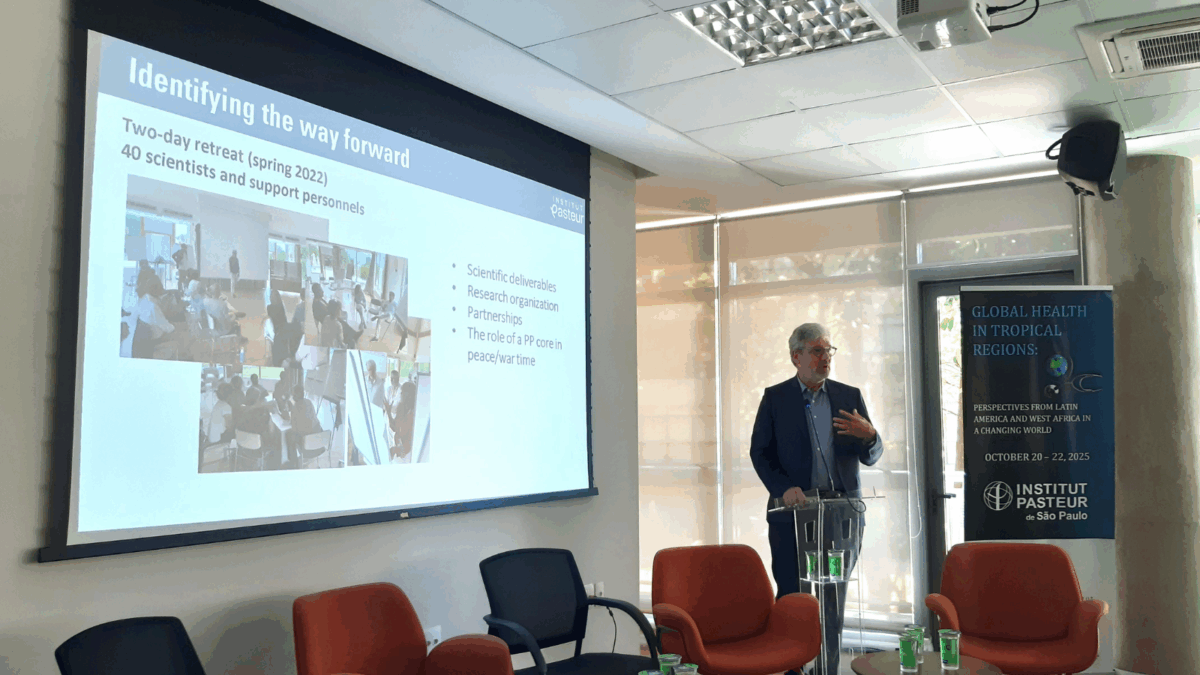
In flash talks opening the last day of the international forum in the Institut Pasteur de São Paulo (IPSP), Christophe Denfert presented the Institut Pasteur’s new initiative for pandemic readiness, while Bérengère Virlon spoke about FrOGH, the French academic network dedicated to collaboration in research and training in global health.
Closing the International Forum “Global Health in Tropical Regions: Perspectives from Latin America and West Africa in a Changing World – French Contributions,” the Institut Pasteur de São Paulo received, on the morning of October 22, two speakers who summarized the spirit of the French-Brazilian scientific cooperation and the global vision about health and sustainability.
Christophe Denfert, scientific coordinator for International Affairs of Institut Pasteur in Paris, presented the Pasteur Initiative for Pandemic Readiness (P3i), designed to strengthen the response capacity of the institute and its international network in the face of future health crisis. Bérengère Virlon, director of the Global Health Department of Institut Pasteur in Paris, explained the composition of the academic network FrOGH (France One & Global Health), which includes 32 French organizations dedicated to research, teaching, and public policy in global health.
From COVID-19’s learning to P3i creation
According to Denfert, the COVID-19 pandemic revealed the necessity to rethink the way scientific institutions organize themselves to react to sanitary emergencies quickly. “We know that there will be a next pandemic – the issue is how we can be better prepared to react to it,” said Denfert.
In 2022, the Institut Pasteur organized a 2-day retreat with 40 researchers and managers to develop an institutional action plan. The result was the creation of P3i, based on four pillars: the enhancement of knowledge on risk pathogens; the amplification of capacities for vaccine and therapy development; the strengthening of epidemiologic intelligence; and the enhancement of institutional organization to respond quickly.
Among the concrete actions, Denfert highlighted the new Center for Diseases Transmitted by Vectors (CMTV), which will be home to 13 research groups across 9,000 sqm of laboratories and was designed to enable the integrated study of vectors, pathogens, and hosts. The institute has also created the Center of Vaccinology and Immunotherapy, aiming to accelerate the development of vaccines and monoclonal antibodies, and to be part of the European Vaccine Hub, funded by the European Commission.
The P3i also invests in creating protocols for the first 30 days of response to a new epidemic, including simulation exercises and training teams capable of working in high-level biosecurity laboratories. “We are rejuvenating our investigation of the outbreaks task force, created in 2010, so that it once again can be mobilized in the field,” Denfert explained.
To Denfert, readiness is not only a technique but also an organizational one: “it is about having an institution ready to react, with trained people, connected partners, and clear procedures to act rapidly.”
FrOGH: a French network to think the global health
In the sequence, Bérengère Virlon presented FrOGH (France One & Global Health), the new French association created to connect universities and research centers around an integrated view of human, animal, and environmental health. Created in 2023, the network already brings together 32 institutions spread across metropolitan and overseas territories.
“The objective is to coordinate a still existent scientific community that is scattered. France has expertise in global health, but it needed to be connected,” explained Virlon.
FrOGH operates on three fronts: fostering synergy across research, training, and consulting; proposing actions and recommendations to domestic and international authorities; and strengthening the visibility of the French global health sciences abroad.
Its first significant event was the FrOGH Forum, held in October, featuring 36 presentations by researchers from across the country, organized into four sessions: global health, community-based approaches, international governance, and training in global health. The works covered studies on the connection between environmental changes and emerging diseases, as well as models of community intervention in Lebanon and Cameroon.
According to Virlon, “these projects show that the French research in global health is inclusive and cross-disciplinary. It is about building knowledge through a dialogue with the communities and to link the local to the global so that the solutions are real and sustainable.” Virlon finished inviting the francophone and international centers to join the network, which will soon have an official website and a Linkedin page.
Convergence between vigilance and cooperation
Both presentations reinforced the same message: the answer to future pandemics depends as much on scientific infrastructures as on institutional and human alliances. While P3i seeks to enhance Institut Pasteur’s scientific agility, FrOGH aims to expand bridges between research, training, and public policy on a global scale, two complementary fronts of the same effort to build a global health system better prepared and collaborative.