
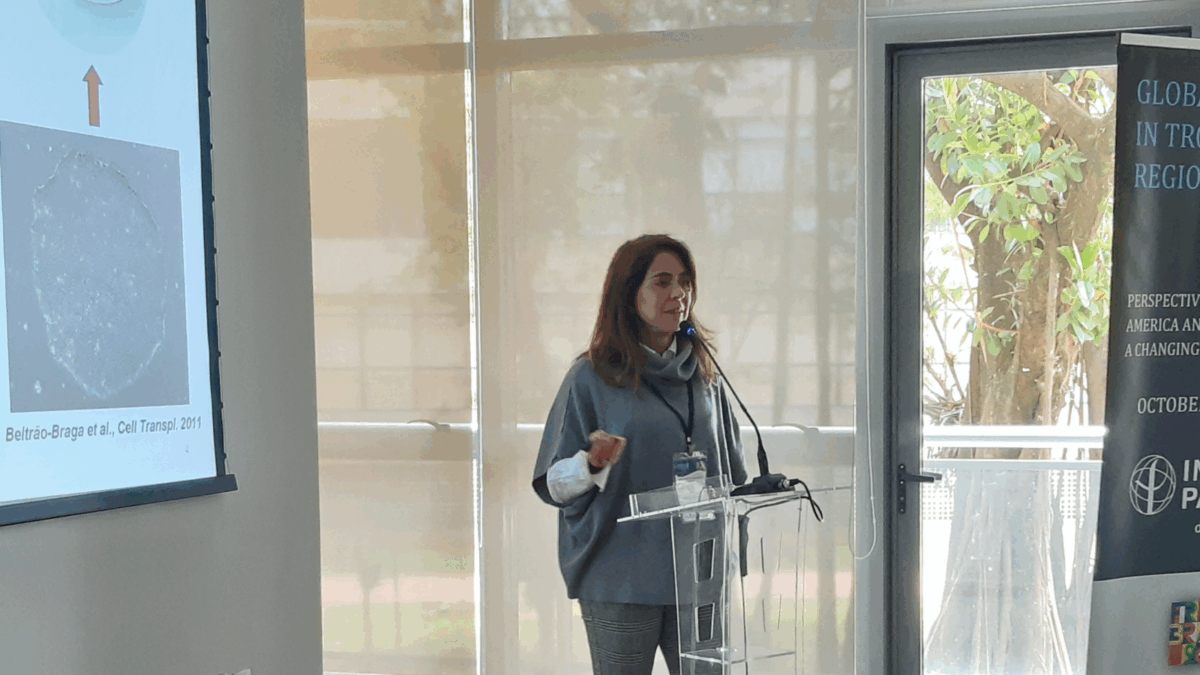
The panel at the Institut Pasteur de São Paulo (IPSP)’s international forum discussed how scientific cooperation can improve responses to brain infections in tropical regions.
Researchers from the Pasteur ecosystem and USP discussed how infectious agents, including viruses and bacteria, interact with the brain and impact neurodevelopment.
The debate took place at the panel Intersections between Neuroscience & Infectious Diseases, during the international forum “Global Health in Tropical Regions: Perspectives from Latin America and West Africa in a Changing World – French Contributions”, held from October 20th to 22nd at the campus of USP.
The forum’s focus was to exchange ideas about how international scientific cooperation can contribute to addressing global health challenges in tropical regions. The Institut Pasteur de São Paulo (IPSP) promoted the event as part of the official program for the Year of France in Brazil 2025.
Neurotropic viruses and autism
Professor Patrícia Beltrão Braga, from the IPSP and the Institute of Biomedical Sciences at USP (ICB-USP), presented results from the Disease Modeling Laboratory, which employs in vitro models and brain organoids developed from pluripotent stem cells to investigate how infections during pregnancy can interfere with neurodevelopment.
Studies show that viral infections, such as the Zika virus, can trigger neuroinflammation processes capable of altering synapse formation and influencing the onset of autism spectrum disorders (ASD).
“Our group observed that neurons formed from autistic children show reduced electrical and chemical activity, and astrocytes with an exacerbated inflammatory response. Blocking IL-6 production was sufficient to restore part of the synaptic communication,” he explained.
Braga also highlighted the use of the antiviral drug sofosbuvir—originally indicated for hepatitis C — as an alternative to prevent vertical transmission of the Zika virus and reduce its neurological effects in experimental models.
Rabies and the brain
Researcher Hervé Bourhy, director of the Global Health Department at the Institut Pasteur de Paris, discussed the ecological and evolutionary behavior of the rabies virus (Lyssavirus)—one of the most neurotropic viruses known—and its implications for human and animal health.
Based on three decades of monitoring bat colonies in Europe and South America, Bourhy showed that the rabies virus are able to circulate for long periods between species without causing mortality, a phenomenon that suggests natural mechanisms of neural tolerance and viral persistence in these animals.
The virus ability to hide itself in natural reservoirs, explained the researcher, makes bat populations a constant link in the ecological chain of rabies. This is why environmental changes caused by deforestation, mining, and human expansion in tropical regions increase the likelihood of contact between humans and vector species, raising the risk of zoonotic brain infections.
Cognitive effects of long COVID
Neuroscientist Guilherme Dias de Melo, from the Institut Pasteur de Paris, presented research on brain changes associated with long COVID based on experimental models in hamsters. The results show that, even after the acute phase of infection, SARS-CoV-2 can remain in the brain at low levels, causing cognitive deficits and lasting behavioral symptoms. Genetic analysis revealed patterns similar to those observed in neurodegenerative diseases, with mitochondrial dysfunction and dopamine loss.
Microbiome and neurodevelopment
Professor Carla R. Tadei, from the Instituto de Ciências Biológicas at USP (ICB-USP), presented results from the Germina Project, part of the international Welcome Leap initiative, which followed 500 Brazilian babies from birth to two years of age to investigate the impact of the gut microbiome on neurological development.
The data shows that exclusive breastfeeding is associated with better cognitive performance and greater microbial diversity, while exposure to lead reduced scores on the cognitive scales applied. The team also identified correlations between vitamin K-producing bacteria and better neurological development.
“These results reinforce the role of the microbiome as an organ in formation in the first thousand days of life — and show that intervening during this period can bring lasting benefits to brain health,” she said.
Microglia and neuroinflammation
Closing the panel, Professor Luiz Roberto G. de Britto, from IPSP and ICB-USP, highlighted the central role of microglia, an immune cell in the nervous system, in mediating inflammatory responses caused by infectious agents. He compared the mechanisms observed in viral infections to those in neurodegenerative diseases such as Alzheimer’ and Parkinson’, showing that the same inflammatory cascade can be triggered by pathogens.
Britto also drew attention to the impact of climate change on the dynamics of these diseases: “Higher temperatures and environmental changes modify the ecology of pathogens and increase the risk of infections with neurological repercussions,” he concluded.