
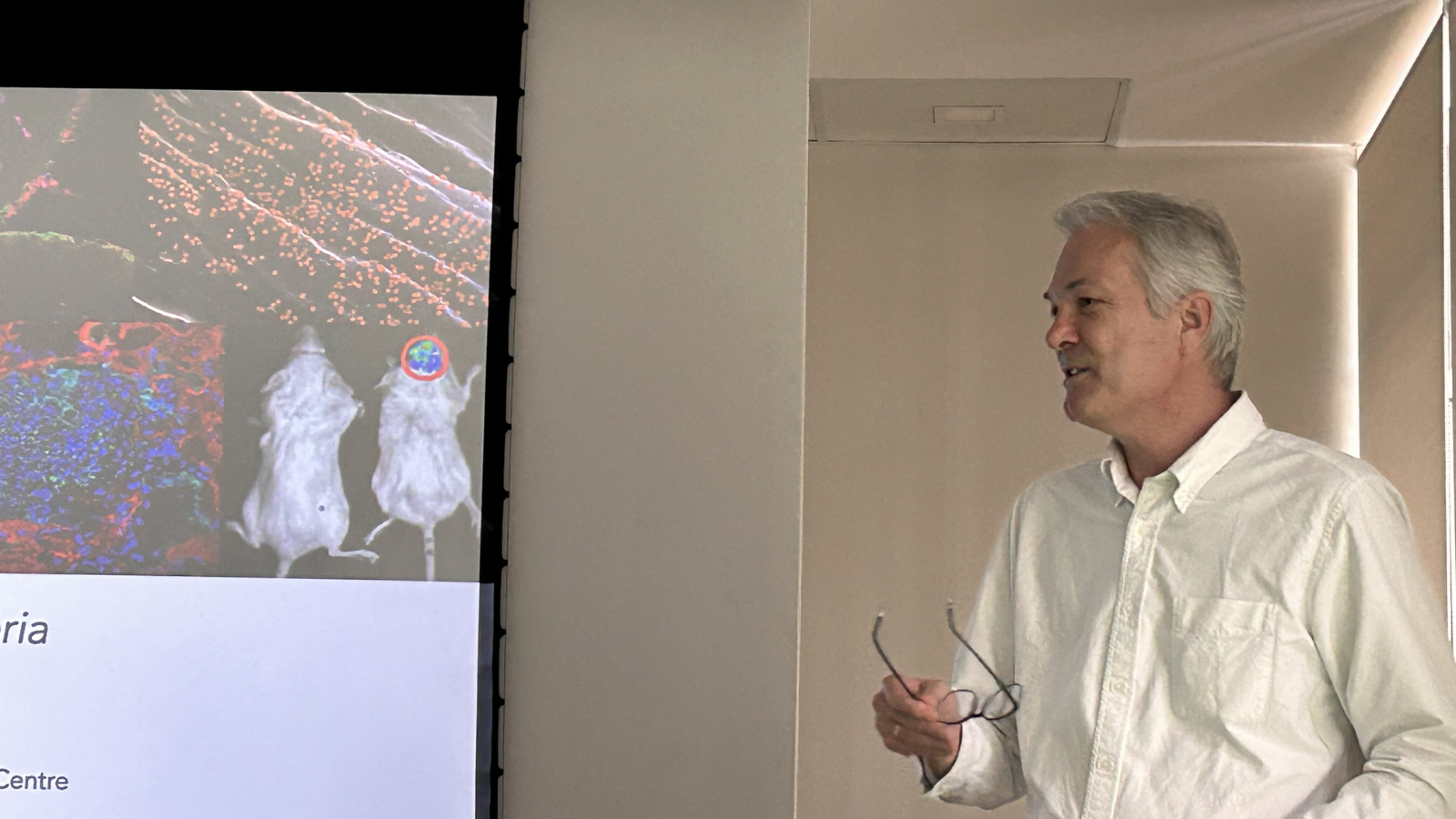
According to the researcher, Listeria monocytogenes goes beyond the disease it causes: by crossing multiple barriers in the body, the bacterium becomes a model for understanding how pathogens disseminate and interact with the immune system.
The bacterium Listeria monocytogenes, responsible for a potentially severe foodborne infection with high morbidity and lethality in vulnerable groups, employs highly specialized mechanisms to cross host barriers, evade immune responses, and spread without being readily detected. This was demonstrated by microbiologist and infectious disease physician Marc Lecuit, from the Institut Pasteur (Paris), Inserm, Université Paris Cité and Necker-Enfants Malades Hospital, during a seminar held at the Institut Pasteur de São Paulo on April 17 in Brazil.
Throughout the presentation, Lecuit detailed how listeriosis serves as a model to understand systemic infections—those in which a pathogen crosses host barriers and disseminates throughout the body via circulation.
Associated with the consumption of contaminated food, listeriosis is, in most cases, asymptomatic or presents with mild symptoms. However, in a subset of infections—particularly in the elderly, immunocompromised individuals and pregnant women—the disease may progress to its invasive form, potentially leading to septicemia and reaching the central nervous system, and the fetoplacental unit, with a high risk of complications and mortality.
“What makes Listeria particularly interesting is that it does not simply invade the host—it does so by exploiting very specific points of vulnerability in host barriers,” Lecuit stated.
Specific entry – One of the key advances discussed concerns how the bacterium crosses the intestinal epithelium. Contrary to what was previously assumed, invasion does not occur diffusely along the mucosa.
Lecuit’s group demonstrated that the bacterium uses the protein InlA to bind to E-cadherin—a molecule present at junctions between epithelial cells—but this interaction depends on regions where the receptor is exposed and accessible. These “entry points” include, in particular, goblet cells.
“This is not a random invasion. The bacterium invades highly precise niches where it can interact with the host”, he explained.
Moreover, the data show that this interaction varies across species, helping to explain differences in susceptibility between experimental models and humans—an important aspect for developing more representative disease models.
Silent dissemination – After crossing the epithelium, Listeria may reach the bloodstream and spread to organs such as the liver and spleen, from which, in some cases, the infection may progress to the central nervous system and the placenta. This process involves sophisticated intracellular mechanisms and various bacterial factors that contribute to dissemination within the host.
Proteins such as LLO allow the bacterium to escape from intracellular compartments, while ActA enables its movement within cells and direct spread to neighboring cells, reducing exposure to the immune system.
In experimental models using intestinal organoids and advanced imaging techniques, the group observed that the bacterium can cross the epithelium through transcytosis—a process in which it passes through cells without damaging the tissue.
“Intestinal infection is silent, practically invisible from an inflammatory standpoint. The bacterium can cross the epithelium without triggering an immediate response, which favors its dissemination,” said Lecuit.
Heterogeneous response – Another central axis is how the immune system responds to infection—and, importantly, how this response varies across different regions of the intestine. The results also indicate that the site and mode of bacterial entry directly influence this response, determining whether the infection evolves in a more silent or inflammatory manner.
Structures such as Peyer’s patches show neutrophil infiltration in response to infection, whereas intestinal villi show little response. In these regions, CX3CR1+ cells produce anti-inflammatory signals and tolerogenic environment—that is, one with a more controlled immune response.
“There is significant heterogeneity in the host intestinal response. In some regions, we observe an inflammatory response; in others, an environment that favors tolerance. This may be decisive for the success of the infection,” he noted.
He also presented the mechanisms by which Listeria evades adaptive immune response, crosses the blood-brain barrier and triggers encephalitis.
More than simply describing the mechanisms of listeriosis, the studies presented by Lecuit indicate that the success of infection depends not only on the bacterium’s invasive capacity but also on how it interacts with the immune system in different host contexts. By exploiting multiple entry routes and evading host responses, Listeria reveals broader principles about infection dynamics—including persistence and dissemination strategies that go beyond the classical clinical picture of the disease.
Head of the Biology of Infection unit, affiliated with the Institut Pasteur, Inserm, and professor of medicine at Université Paris Cité and Necker-Enfants Malades Hospital, Lecuit also directs the Listeria National Reference Center and collaborating center of the World Health Organization, working at the interface of basic research, clinical science, and epidemiological surveillance.