
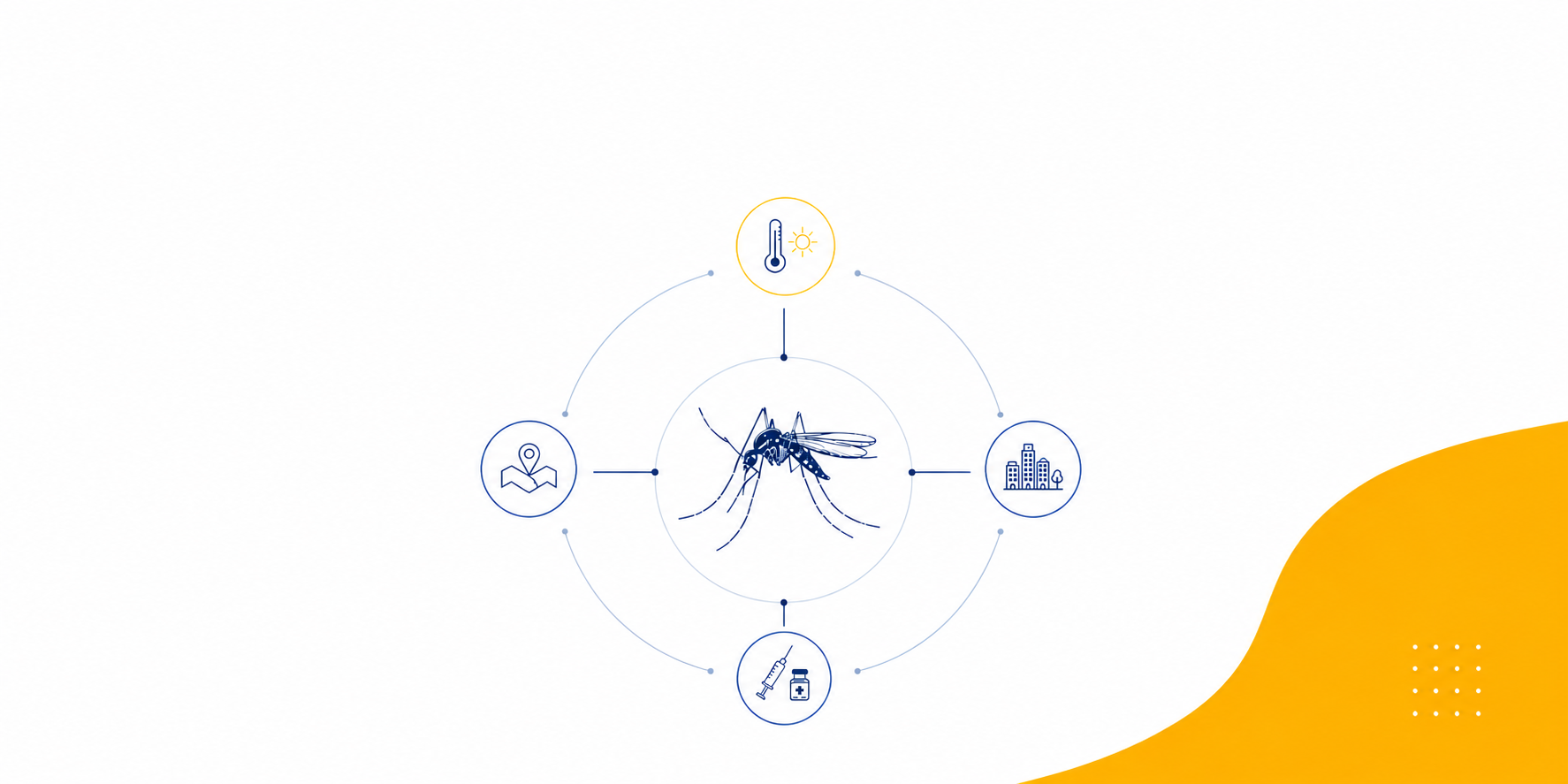
Research combines climate, environmental and behavioral data to generate high-resolution risk maps and support more targeted public health interventions
Dengue remains one of Brazil’s most pressing public health challenges. Although climatic factors such as temperature and humidity have long been recognized as important drivers of the disease, researchers at the Institut Pasteur de São Paulo (IPSP) believe that part of the explanation for dengue outbreaks may lie in much more detailed features of the urban landscape.
To investigate this phenomenon, IPSP is developing a new research project that aims to integrate artificial intelligence, climate data, environmental indicators, urban infrastructure information and public perceptions of vaccination to create a system capable of identifying areas at greater risk of dengue transmission in São Paulo.
The goal is to understand how climatic factors, urban conditions and vaccine acceptance interact to influence dengue outbreaks. The initiative is coordinated by researcher Mauro César Cafundó de Morais, head of the Climate and Health Laboratory at the IPSP, and brings together national and international partners, including the Institut Pasteur in Paris.
“Our objective is to understand how different environmental, social and climatic factors interact to favor dengue transmission within the city. We already know that risk is not distributed homogeneously. There are very specific areas where multiple factors converge, creating more favorable conditions for mosquito proliferation and disease occurrence,” explains Morais.
In addition to traditional climatic variables such as temperature and humidity, the researchers intend to examine factors that have received limited attention in epidemiological studies, including urban heat islands, access to water, sewage collection systems and the availability of urban services.
The hypothesis is that the convergence of these elements may help explain why certain regions experience higher dengue incidence rates than neighboring areas exposed to similar seasonal conditions.
High-resolution neighborhood risk maps – One of the project’s main innovations is the development of models capable of generating high-resolution spatial risk maps. While many current systems rely on data aggregated at the city or regional level, the IPSP approach seeks to identify patterns at much smaller scales, reaching the neighborhood level and, eventually, individual city blocks.
According to Morais, this strategy could contribute to a more efficient allocation of public resources dedicated to dengue control.
“If we can identify with greater precision where risk is increasing, surveillance teams will be able to direct their actions more strategically, whether through prevention campaigns, community health visits or mosquito breeding site control,” he says.
The researchers also expect the models to support the development of early-warning systems, helping public authorities implement preventive measures before outbreaks reach larger proportions.
Social listening and vaccine confidence – Another component of the project involves monitoring social media conversations to better understand public perceptions of the dengue vaccine, which has recently become part of prevention strategies in Brazil.
This approach, known as social listening, seeks to identify questions, concerns and public perceptions through content shared on digital platforms. The aim is not to verify individual posts but rather to understand broader behavioral trends and levels of trust related to vaccination.
“We want to understand how people perceive the vaccine and which factors influence adherence to immunization campaigns. This information can help guide communication strategies and strengthen public confidence,” the researcher explains.
The study also intends to assess the perceptions of healthcare professionals, who play a crucial role in vaccine recommendations and in building public trust.
A One Health approach – The project is aligned with the One Health strategy adopted by IPSP and the Pasteur Network, which recognizes the interconnectedness of human, animal and environmental health.
The research is being developed amid growing international concern about the impact of climate change on vector-borne diseases. In recent years, dengue has expanded into regions previously considered low-risk, including parts of southern South America and several European countries.
In April, Morais participated in the One Health Summit in Lyon, France, where he presented Brazilian initiatives focused on monitoring climate-sensitive diseases. The event brought together scientists, international organizations and government representatives to discuss global strategies for adapting health systems to climate-related challenges.
“There is no vaccine against global warming. But we can use data, science and technology to anticipate risks and support decisions that reduce the impact of these changes on population health,” says Morais.
The researchers expect the project’s findings to contribute to the development of new epidemiological surveillance tools and to support more effective public policies for tackling dengue and other climate-sensitive diseases.