
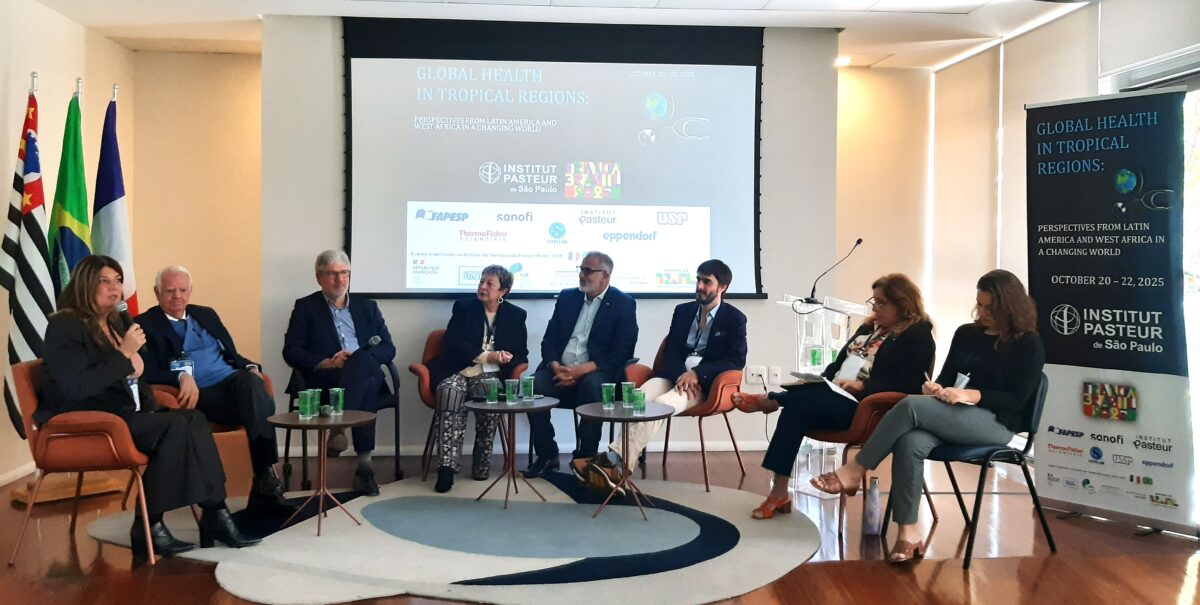
The final roundtable, marking the end of the international forum held at the Institut Pasteur de São Paulo, brought together Brazilian and French institutions to discuss a shift in their partnership. The question at hand: how to transition from occasional collaborations to an integrated scientific strategy?
The final roundtable of the international forum “Global Health in Tropical Regions: Perspectives from Latin America and West Africa in a Changing World – French Contributions” was held at the Institut Pasteur de São Paulo (IPSP) on October 22nd. It brought together representatives of Centre National de Recherche Scintifique (CNRS), Institut de Recherche pour le Dévelopement (IRD), Institut Pasteur de Paris, Fundação Oswaldo Cruz (Fiocruz), Fundação de Amparo à Pesquisa do Estado de São Paulo (FAPESP), Escola Superior de Agricultura Luiz de Queiroz (Esalq/USP), Institut national de de la santé et de la recherche médicale – Agence nationale de recherche sur le Sida et les hépatites virales –, Maladies infectieuses émergentes (Inserm–ANRS–MIE), and the French Embassy in the Federative Republic of Brazil.
They agreed that cooperation between the two countries is already robust and diverse; the challenge now is to bring these initiatives together under a shared, long-term strategic framework.
Vincent Brignol, Scientific Attaché at the French Consulate in Rio de Janeiro, recalled that the Brazil–France Joint Committee for Scientific Cooperation was created after President Emmanuel Macron’s visit, when it identified health research as one of its four main priorities.
“Brazil is one of the few countries where we have a formal scientific governance structure,” he said. Brignol emphasized the need to align programs such as Capes–Cofecub, Fapesp–ANR, and Fapesp–Inserm to enhance Brazilian access to European funding and to foster scientific mobility.
PRISMA: connecting research initiatives
Researcher Erika Telford, from ANRS–MIE, presented PRISMA (International Platform for Global Health Research), launched on October 1st in Fortaleza, Ceará State. The consortium brings together nine French and Brazilian institutions, including the Institut Pasteur de Paris, IRD, the Ministry of Health, Inserm, the Ministry of Science, Technology, and Innovation, and Fiocruz. “PRISMA was not created to replace existing programs but to connect them and give them direction,” she explained. “We want to create a shared planning space with common priorities and a unified funding calendar.”
Telford also emphasized that the platform was conceived as an open and inclusive consortium, designed to evolve in phases and incorporate new partners over time. She proposed creating a joint information portal, hosted by either a Brazilian or French institution, to share calls and cooperation opportunities. Communication, she stressed, will be a key element of PRISMA. Participants in the audience reinforced the idea, suggesting that the portal should centralize funding calls and announcements from both countries.
Voices from French research institutions
Christophe Denfert of the Institut Pasteur de Paris highlighted Brazil’s central role in the Pasteur Plan 2030, noting its scientific excellence and leadership in South–South cooperation. “The Pasteur system values alliances that combine scientific excellence and social impact. Brazil, with its strengths in biology, surveillance, and public health, is a cornerstone of the Pasteur Network,” he said. Denfert also highlighted the potential of the Institut Pasteur de São Paulo to serve as a regional hub, capable of integrating initiatives across Latin America and Lusophone Africa on topics such as infectious diseases and antimicrobial resistance.
Riteau, from CNRS, with over 80 international laboratories worldwide, including 10 in Latin America, introduced the IMEA (Immunity, Infection, and Cancer) International Research Laboratory in Ribeirão Preto, which studies immunopathological mechanisms of infections. He underscored the long-standing partnership with Brazil, established over 40 years ago, and the importance of researcher mobility across all career stages, as well as closer coordination among CNRS, ANR, Inserm, and Institut Pasteur to strengthen joint scientific governance between both countries.
Abdelfettah Sifeddine, Director of the Institut de Recherche pour le Développement (IRD) in Brazil, emphasized the need to strengthen the links between research, public policy, and local communities. He recalled that the IRD has been active in the Amazon and Northeastern Brazil for decades, working on projects related to climate, biodiversity, and environmental health. Collaboration with Brazilian institutions, he said, is essential to understanding the ongoing ecological transformations. “The boundaries between health and the environment no longer exist. We need science that engages with the land and with the people who inhabit it,” he stated.
Science, sustainability, and education
Thaís Vieira, Director of Esalq/USP, proposed expanding cooperation to include food systems, ecology, and public health, connecting agricultural and biomedical research. “Brazilian agroecological knowledge and French expertise in nutrition and microbiome research complement each other,” she noted.
She announced the creation of the Universidade de São Paulo–International Center for Planetary Health (USP-INRAE), a partnership with the French government recognized by the Food and Agriculture Organization (FAO) for developing the concept of Foodomics, which integrates omics sciences with food and nutrition research. “We cannot discuss climate change without considering food and nutrition. That is what connects agriculture, ecology, and health,” she concluded.
Infrastructure, interoperability, and funding
Ilka Villardo of Fiocruz stressed the need for improved interoperability and data sharing in epidemiological and genomic surveillance. She advocated for an open-science infrastructure to enable faster information exchange between institutions in both countries.
From FAPESP, Raul Machado Neto recalled that France is the foundation’s third-most-important international partner and suggested creating funding lines dedicated to short-term mobility, describing this as “the first step toward lasting partnerships.” He also underscored the need for greater predictability and coordination among funding agencies, noting that FAPESP maintains specific programs with the Institut Pasteur and other French research centers.
Paola Minoprio, Executive Director of the Institut Pasteur de São Paulo (IPSP), added that the creation of the FAPESP–Institut Pasteur Young Investigators Program stemmed from a pioneering partnership that has already resulted in two active research groups, led by Luiz Gustavo Góes and Rubens Alves, with a third scheduled to begin operations in December under researcher Caio Haddad.
The role of IPSP in the new cooperative architecture
Paola Minoprio presented the vision of the Institut Pasteur de São Paulo (IPSP) as both a scientific and diplomatic platform. She announced plans to create new research platforms in structural biology, cytometry, recombinant proteins, and biological collections, which will serve as foundations for training, capacity-building, and researcher exchanges.
“The Institut Pasteur de São Paulo aims to become a regional hub for scientific training, open to researchers from both the Pasteur Network and Brazilian institutions,” she said.
She also mentioned a proposal for an expanded research and training center designed to integrate these platforms and host long-term collaborative projects. “We have the technical expertise; now we need the structure that allows knowledge to circulate,” she stated.
Closing the session, Minoprio thanked the participants and reaffirmed the importance of cooperation as both a scientific and human value. “We are researchers; we want to work together—that is what unites us. Our mission is to seek solutions for humanity,” she said.
She reminded the audience that the Institut Pasteur de São Paulo was founded on a strong scientific strategy based on complementarity and rapid responses to health emergencies, ending with a note of optimism: “May this be only the beginning of many meetings and new collaborations between Brazil and France.”