Event convened by France ahead of the G7 brought together heads of state and the scientific community to redefine global health strategies
Researcher Mauro César Cafundó de Morais, from the Institut Pasteur of São Paulo (IPSP), took part in the One Health Summit, held from April 5 to 7, 2026, in Lyon, France, contributing to the development of scientific recommendations that are expected to guide global public policies in response to the growing health, climate, and environmental crises. The meeting was organized by France as part of the international discussions leading up to the G7 and included the participation of President Emmanuel Macron, who opened the high-level session focused on the global health architecture.
The event gathered around 2,000 participants — including heads of state, international organizations, scientists, and policymakers — and resulted in the publication of the document “The Lyon Commitments for Health for All Life and the Planet”, which establishes strategic guidelines for implementing the One Health approach.
The main proposed shift is structural: strengthening prevention as the central pillar of health systems, alongside data integration and international cooperation. “Climate change is altering the profile of diseases and requires health systems to adapt. The challenge now is to anticipate risks based on evidence and translate this into public policies,” says Morais.
Science guiding policy – The Summit’s final document consolidates 47 recommendations developed by international experts, organized around a central principle: human, animal, and environmental health must be treated as a single, interdependent system.
Among the main guidelines are:
• strengthening integrated surveillance to anticipate emerging and re-emerging diseases
• using data and advanced technologies (including artificial intelligence) to predict outbreaks
• addressing antimicrobial resistance as a global systemic challenge
• tackling pollution as a direct health risk factor
• transforming food systems with a focus on health and sustainability
• integrating science and public policy through cross-sector coordination
The document also emphasizes the need to overcome fragmentation between fields — the so-called “silos” — by promoting coordinated action across sectors and disciplines.
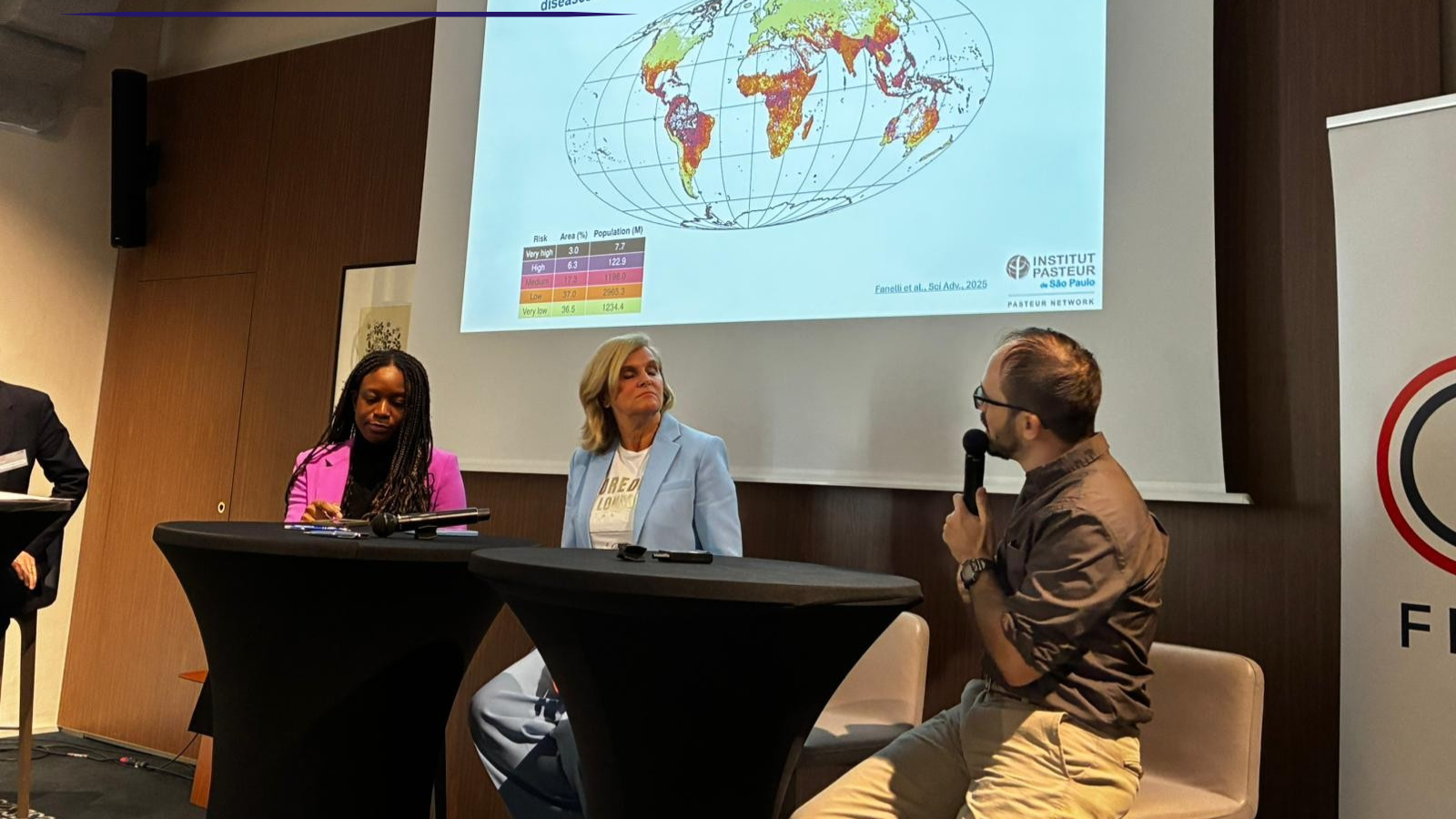
Brazilian project – At the Summit, Morais participated in discussions on the impact of climate change on the dynamics of infectious diseases — one of the central themes of the international agenda. He presented his work at IPSP during an event organized jointly with the World Health Organization (WHO).
The research investigates how climate variables, such as temperature and precipitation, influence the transmission of vector-borne diseases, including dengue, yellow fever, and leishmaniasis. The work directly aligns with one of the document’s priority recommendations: the development of surveillance systems capable of anticipating outbreaks more accurately through the integration of climate, environmental, and epidemiological data.
“Today, we still work with broad forecasts, often annual. The challenge is to move toward more precise scales, both spatially and temporally, to enable faster and more effective responses,” he explains.
From global to local – One outcome of the project is an ongoing partnership with the Health Surveillance Coordination Office (Covisa) of the São Paulo City Hall, aimed at improving dengue monitoring. The initiative seeks to increase the spatial resolution of data — moving from large-area analyses to more detailed scales such as neighborhoods or even city blocks — and to enhance temporal predictability, which is currently based on seasonal cycles, by enabling more refined monthly or weekly analyses. Another objective is to optimize the allocation of operational resources, allowing field actions to be more precisely targeted.
During the Summit, Morais was invited to present, in a meeting with the French Ministry of Health and the WHO, the climate and health research agenda developed at IPSP, including initiatives focused on monitoring diseases sensitive to environmental variables. In this context, the dengue surveillance model in the city of São Paulo was presented as one of the applied cases, attracting interest due to its responsiveness and data availability.
In this sense, the research conducted at IPSP aims to advance precisely along this frontier: making monitoring systems more accurate while also more cost-effective, expanding their potential application across different cities and countries. This approach directly responds to one of the Summit’s core guidelines: making health systems more resilient to climate change through evidence-based strategies.
International collaboration – Beyond formal recommendations, the One Health Summit also served as a platform for global coordination. Based on the connections established, IPSP is expected to expand its participation in international research and epidemiological surveillance networks.
“The meeting brought researchers and decision-makers closer together. Now, the next step is to turn these connections into concrete partnerships and collaborative projects,” says Morais.
***
About the One Health Summit
Held in Lyon, the One Health Summit marked World Health Day and preceded the G7 agenda under the French presidency. The event gathered:
• 2,000 participants
• more than 250 speakers
• a high-level session with heads of state and international organizations
• a scientific symposium with around 700 participants
The meeting resulted in a set of commitments and recommendations that may guide public policies on a global scale in the coming years.