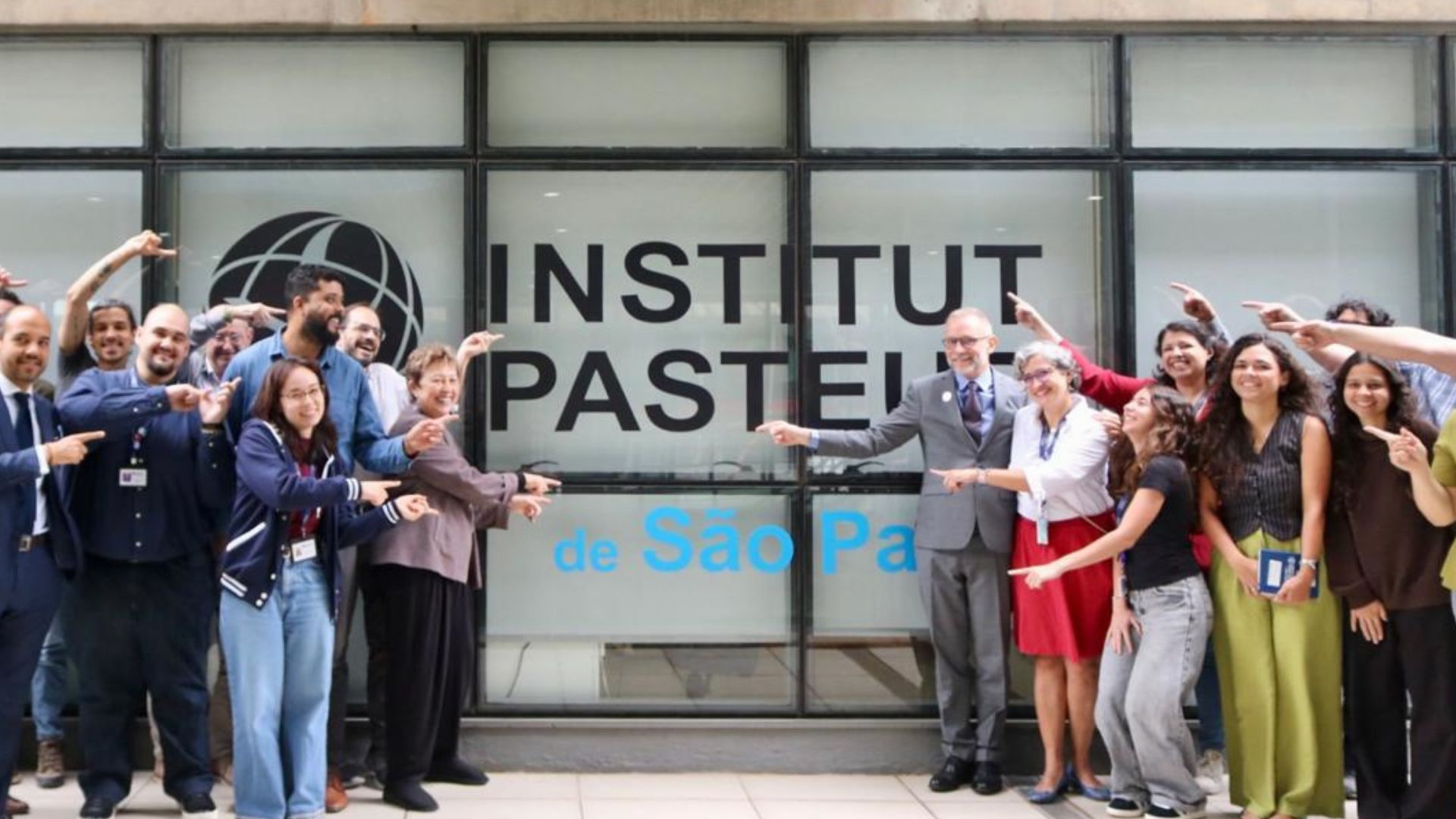
Julien Steimer was welcomed by the IPSP leadership and spoke with researchers about infectious disease surveillance, vaccine development, antimicrobial resistance, and the effects of climate on health.
France’s ambassador to Brazil, Julien Steimer, visited the Institut Pasteur de São Paulo (IPSP) on Friday, November 27, at the University of São Paulo campus in São Paulo. He was welcomed by the institute’s Executive Director, Paola Minoprio, and by Gérard Chuzel, Head of the Financial and Project Administration. The visit included a presentation on the institute’s history, a discussion with research group leaders, and a tour of the laboratories.
The French delegation also included Yannick Samson, Attaché for Cooperation and Cultural Affairs at the Consulate General of France in São Paulo, and Sarah Madjour, Science and Technology Adviser in the consulate’s Cooperation and Cultural Affairs Service.
In her presentation, Minoprio traced the history of scientific cooperation between France and Brazil, from the correspondence between Louis Pasteur and Dom Pedro II to the partnership between the Institut Pasteur in Paris and the University of São Paulo (USP) that led to the creation of IPSP. She noted that the institute’s teams were already conducting COVID-19 research during the pandemic, when the initiative still operated as the Pasteur–USP Scientific Platform. French President Emmanuel Macron officially inaugurated the institute in 2024.
From infectious disease surveillance to researcher training
IPSP researchers presented studies on emerging viruses, genomic surveillance, and vaccine development. The projects discussed included research on viruses in wildlife and on microorganisms of public health concern in urban rodents, as well as efforts to develop treatments for multidrug-resistant pathogens.
The delegation also learned about an initiative that uses artificial intelligence to study how climate conditions influence the distribution of diseases. The project aims to generate information that can support the work of climate monitoring and public health surveillance teams.
Minoprio also highlighted two training and science outreach initiatives. An international school on global health brought together 16 participants from different countries for fieldwork in the Amazon and laboratory work at IPSP. In partnership with the Consulate General of France in São Paulo, the institute also welcomed school students for a science day that included conversations with researchers and hands-on activities.
The meeting was attended by research group leaders Professor Sergio Costa Oliveira (Vaccinology), Professor Carsten Wrenger (Clinical and Molecular Virology), Rúbens Alves (Genomic Surveillance and Vaccine Innovation), Angelica Cristine de Almeida Campos (Viral Spillover & One Health Lab), Robert Andreata Santos (Urban Rodent Virology Lab), Luiz Gustavo Góes (Eco-epidemiology, Diversity, and Evolution of Emerging Viruses), Mauro César Cafundó de Morais (Climate and Health Laboratory), and Caio Haddad Franco (Therapeutics for Combating Multidrug-Resistant Pathogens). Professor Vasco Ariston de Carvalho Azevedo of the Federal University of Minas Gerais (UFMG), who recently joined IPSP as a visiting researcher, also attended.