Joint projects, shared infrastructure, exchanges and funding are among the opportunities discussed by the institutions.
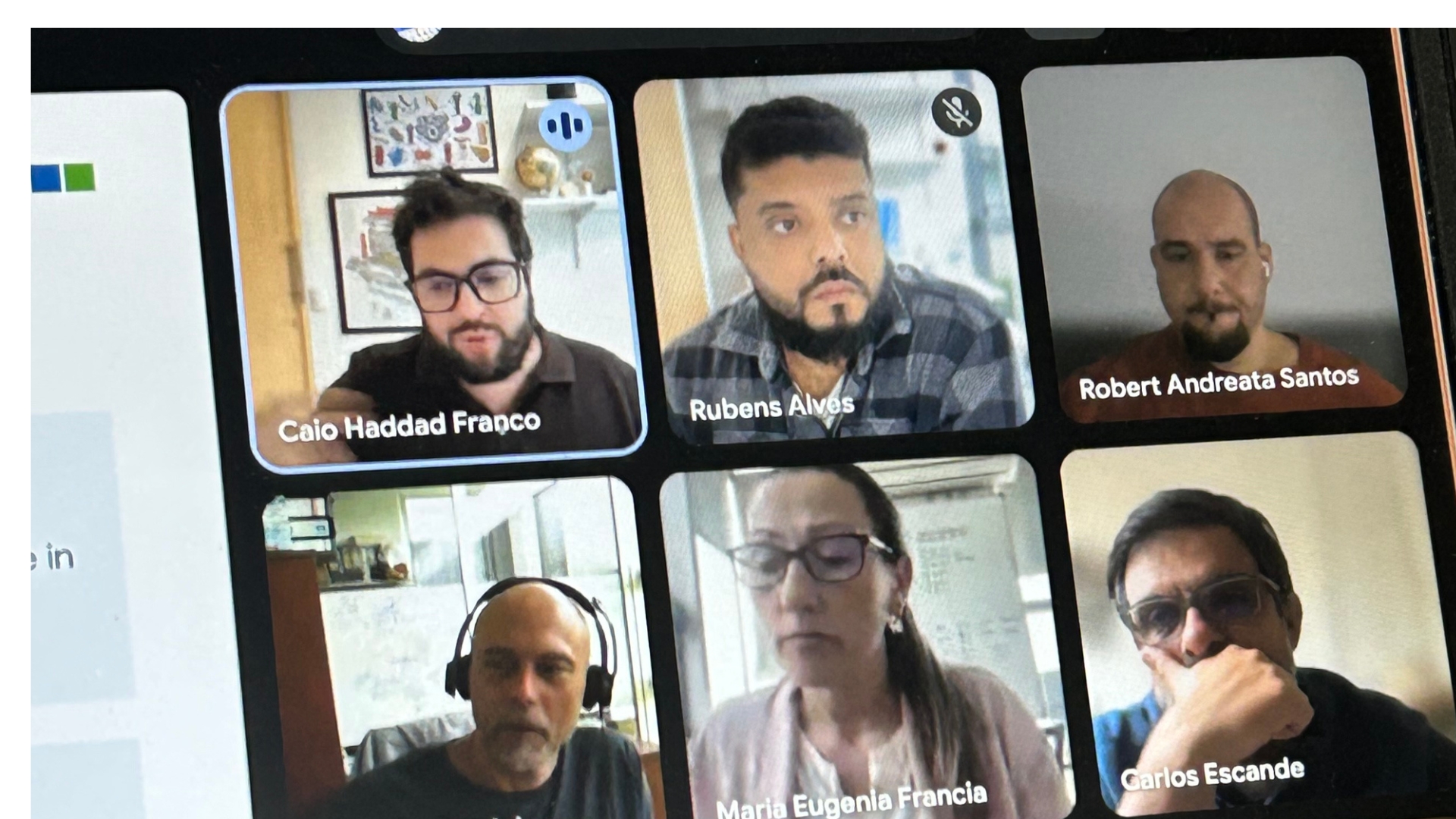
The Institut Pasteur de São Paulo (IPSP) and the Institut Pasteur de Montevideo (IPMon) held an online meeting on October 6 to review the outcomes of the scientific meeting organized by the institutions in September and discuss the next steps in their cooperation. The discussion focused on identifying opportunities for collaboration arising from the connections established during the event, with a view to developing joint projects and initiatives.
Participants included Caio Franco, Robert Andreata-Santos, Angélica Campos, Mauro Morais, Gustavo Góes and Rúbens Alves from IPSP, and Marcelo Comini, Carlos Escande, Alícia Costábile, Vanessa Piattoni and Maria Eugenia Francia from IPMon, among other researchers. The meeting followed up on the Pasteurean Scientific Meeting, held on September 16–18 at the University of São Paulo (USP), which featured 33 presentations from the two institutions.
Key topics discussed included:
· Joint research: identifying connections in areas such as congenital and parasitic infections, regional One Health surveillance, structural and translational research on flaviviruses, drug discovery, and studies of population immunity and ancestry.
· Shared infrastructure: a proposal for a joint catalogue of scientific platforms, including contact persons for each facility, to facilitate access to resources such as animal models, organoids, advanced bioimaging and compound screening.
· Training and exchanges: opportunities for short visits, training for researchers and technical staff, joint supervision of students, and jointly organized courses and workshops.
· Funding and innovation: discussion of funding opportunities through the São Paulo Research Foundation (FAPESP), the National Agency for Research and Innovation (ANII), the Pasteur Network and other international cooperation mechanisms. Andreata-Santos highlighted the importance of incorporating innovation into the proposals, drawing on the institutes’ experience in compound discovery and technology development.
· Next steps: a proposal to establish thematic working groups, with representatives from both institutes, to assess priorities and develop potential collaborations. Participants also discussed organizing joint courses, workshops and training activities, as well as another in-person scientific meeting planned for two years from now.
The proposals will be shared internally for input from the teams. Decisions on which activities to pursue will depend on researchers’ interests, the availability of staff and resources, and the conditions needed to carry out each initiative.