
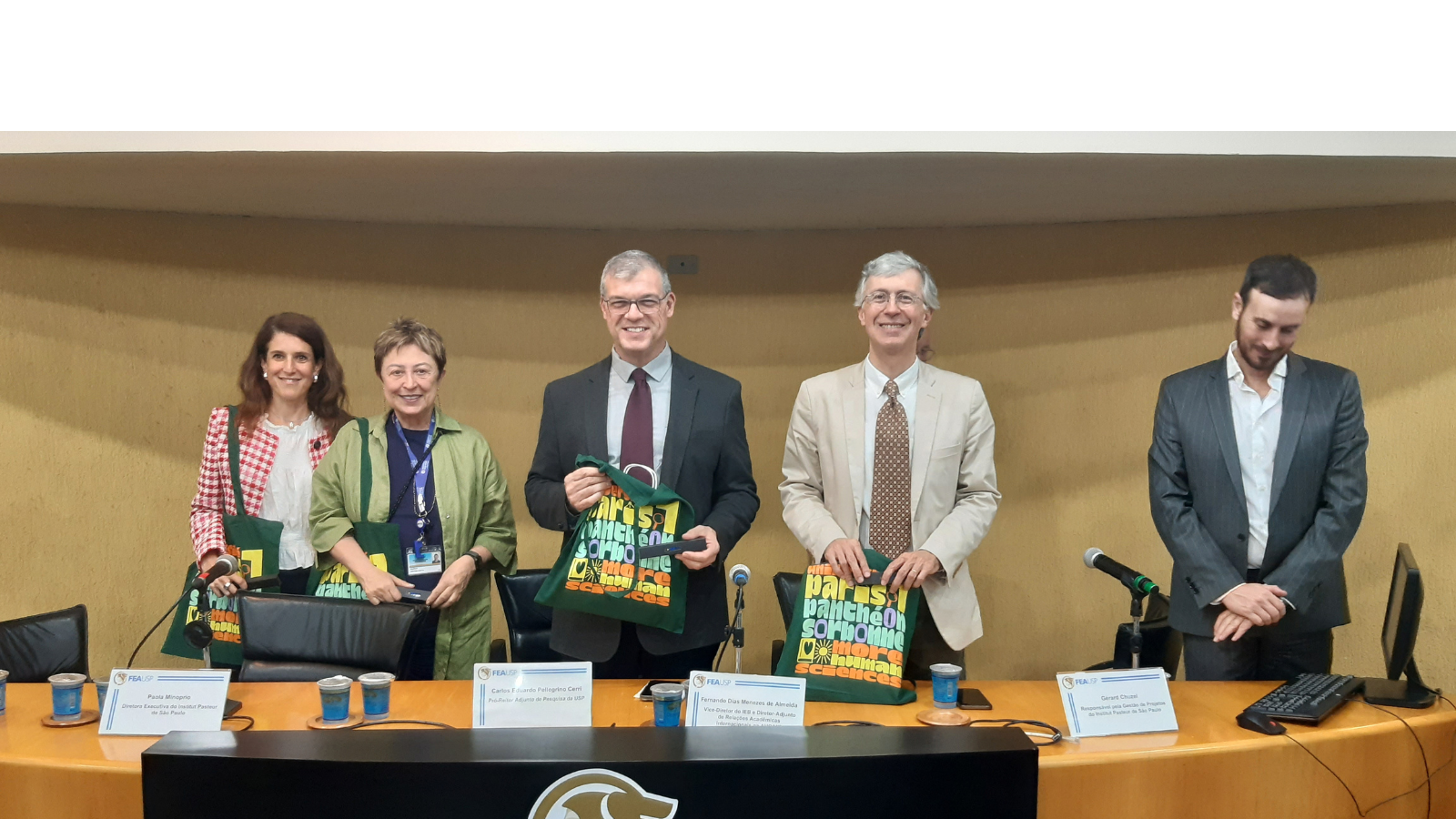
Representatives of the Institut Pasteur de São Paulo took part in a discussion on new models of scientific, academic and business cooperation during an event marking the launch of the Master Management de l’Innovation, a partnership between FEAUSP and Université Paris 1 Panthéon-Sorbonne.
The School of Economics, Business Administration, Accounting and Actuarial Science of the University of São Paulo (FEAUSP) and Université Paris 1 Panthéon-Sorbonne officially launched the Master Management de l’Innovation on Monday (21), an international program developed by FEAUSP and the École de Management de la Sorbonne (EMS). Aimed at FEAUSP undergraduate students, the program expands opportunities for international education in innovation management. Academic activities are conducted in English, in São Paulo, by faculty members from the Sorbonne.
Part of the Franco-USP Weeks program, the event brought together representatives of Brazilian and French institutions to discuss innovation, entrepreneurship, sustainability and new opportunities for cooperation between the two countries.
The program opened with an inaugural panel featuring USP Rector Aluisio Augusto Cotrim Segurado; FEAUSP Dean João Mauricio Gama Boaventura; Aucani President Carlos Gilberto Carlotti Júnior; Université Paris 1 Panthéon-Sorbonne Vice-President for International Relations Rémi Bazillier; and Consul General of France in São Paulo Alexandra Mias. Afterwards, FEAUSP Business Administration student Breno do Prado Silva spoke on behalf of the program’s first cohort, and representatives from the School’s departments discussed the importance of innovation and entrepreneurship in student education.
One of the event’s discussions was the roundtable “Building research, innovation and entrepreneurship ecosystems: cooperation between France and Brazil”, which featured three representatives of the Institut Pasteur de São Paulo: Fernando Dias Menezes de Almeida, President of the IPSP Administrative Council; Paola Minoprio, Executive Director; and Gérard Chuzel, Head of Project Management.
During the discussion, Fernando Dias Menezes de Almeida highlighted the level of maturity reached by Franco-Brazilian cooperation. According to him, this relationship has moved beyond traditional models based primarily on the mobility of students and researchers and is advancing toward more integrated forms of collaboration, involving academic programs, curricula and institutional structures jointly developed by the two countries. The IPSP itself was cited as an example of this new stage of cooperation, as it was established jointly by USP and the Institut Pasteur as an institution created through partnership.
Paola Minoprio presented the trajectory behind the establishment of the IPSP and highlighted the scientific opportunities created by the partnership between USP and the Institut Pasteur. She described Brazil as a strategic environment for research on infectious diseases, emerging viruses, epidemiological surveillance and biodiversity, including issues related to the effects of climate change on health.
Minoprio also emphasized the importance of scientific relationships based on reciprocity. “In this model, foreign researchers interested in scientific and public health issues present in Brazil can develop their projects in the country, in collaboration with Brazilian institutions and researchers — strengthening the country’s capacity to produce knowledge based on its own biodiversity and scientific challenges,” she said.
Gérard Chuzel discussed the evolution of scientific and technological cooperation between France and Brazil over recent decades. According to him, a relationship that was once strongly focused on scientific production has expanded to include technology transfer, capacity building, professional training and closer interaction between universities and companies. Chuzel also highlighted the importance of instruments and legal frameworks that facilitate this interaction and help transform scientific knowledge into innovation.
The panel also included Carlos Eduardo Pellegrino Cerri, USP Associate Provost for Research, and Béatrice Mayence, representative of French Tech São Paulo and the France-Brazil Chamber of Commerce (CCFB), broadening the discussion on opportunities for collaboration between the research, innovation and entrepreneurship ecosystems of both countries.
The program concluded with the roundtable “From innovation to impact: society, sustainability and new economic models”, featuring Amâncio Jorge da Silva Nunes de Oliveira, USP Associate Provost for Culture and Extension; Graziella Comini, Vice-Chair of FEAUSP’s Department of Business Administration; and Rodrigo de Castro Mousinho, of Business France Brazil.