
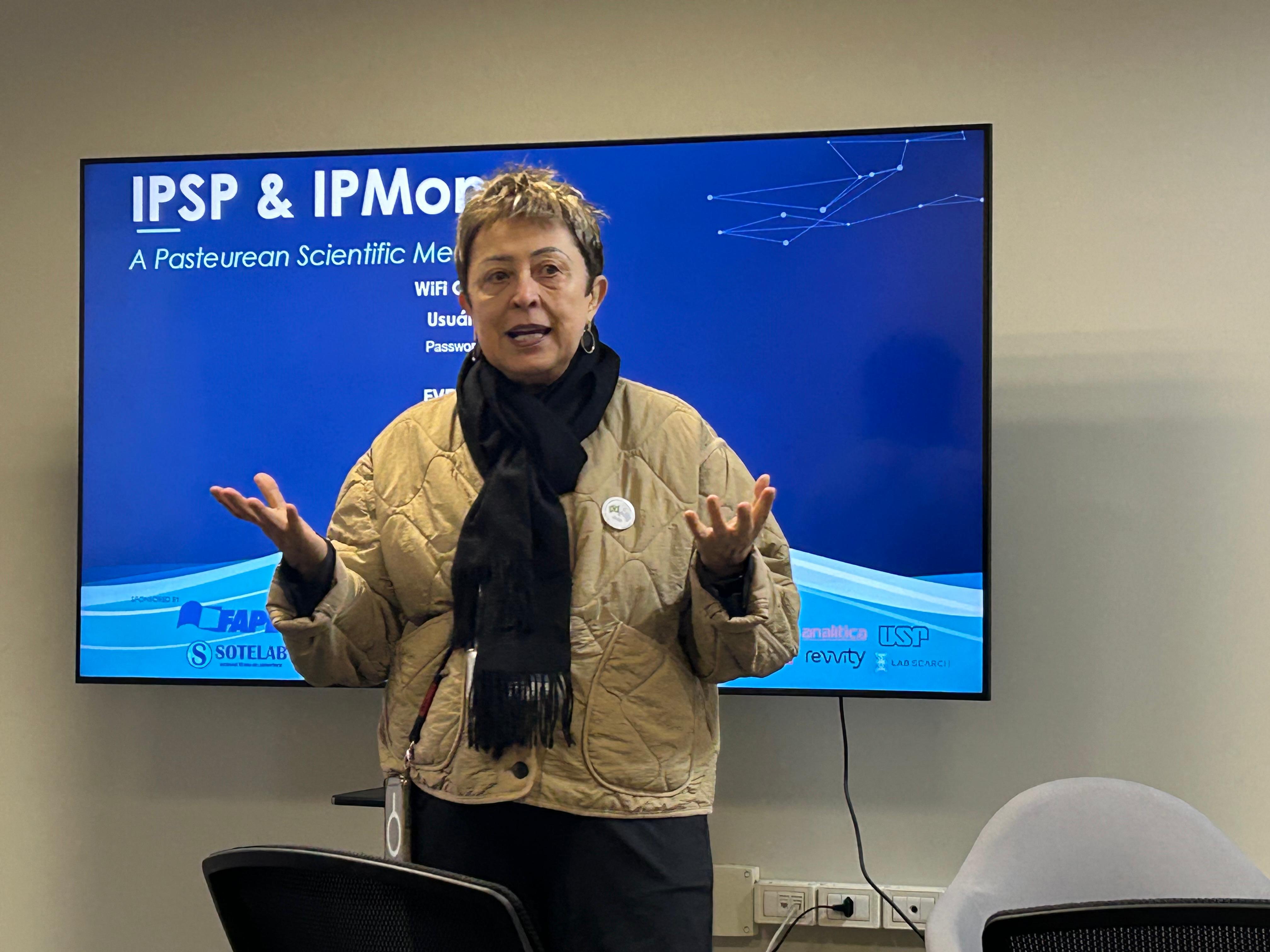
The opening of IPSP & IPMon – A Pasteurean Scientific Meeting highlighted the development of joint projects, science diplomacy, and stronger collaboration among Brazil, Uruguay, and France.
Scientific ties between the Institut Pasteur de São Paulo (IPSP) and the Institut Pasteur de Montevideo (IPMon) took center stage at the opening of IPSP & IPMon – A Pasteurean Scientific Meeting, which began yesterday (September 16) at the University of São Paulo (USP). The meeting was conceived to expand cooperation between the two institutes, identify complementary areas of expertise, and foster the development of joint projects.
At the opening, IPSP Executive Director Paola Minoprio revisited the history connecting the two institutions. In the early 2000s, she took part in the creation of the Institut Pasteur de Montevideo and recalled that the experience had a direct influence on her later career in Brazil, where she worked to make the establishment of the Institut Pasteur de São Paulo possible.
According to Minoprio, despite their geographic proximity and shared scientific interests, the two institutes still knew relatively little about each other’s work. The meeting was conceived precisely to bridge this gap and create concrete opportunities for collaboration. She also highlighted the support of FAPESP, which maintains a cooperation agreement with the Institut Pasteur de Montevideo aimed, among other goals, at fostering closer ties between researchers, developing joint projects, promoting student mobility, and supporting the development of young scientists.
Minoprio said the expectation is that this will be the first in a series of meetings between the institutions. She also emphasized the decision to directly involve younger researchers in the scientific organization of the event, allowing new collaborative networks to grow and become established through this new generation.
Yannick Samson, Attaché for Cooperation and Cultural Affairs at the Consulate General of France in São Paulo, then placed the meeting within the broader context of science diplomacy. In his view, science plays a role that goes beyond the production of knowledge: it can serve as an instrument for cooperation and for building bridges between countries and institutions.
Samson highlighted values associated with international scientific cooperation, including academic freedom, scientific integrity, and reciprocity, and linked the meeting to the One Health approach, which integrates human, animal, and environmental health. He also underscored the role of the Institut Pasteur de São Paulo in scientific cooperation between France and Brazil, noting that closer ties with Montevideo extend this collaboration to a regional dimension involving France, Brazil, and Uruguay.
The institutional presentation of the Institut Pasteur de Montevideo was delivered by researcher Marcelo Comini, who stressed that the Uruguayan delegation had not come to São Paulo simply to present scientific results, but primarily to identify shared interests and opportunities for complementary technological development.
Comini presented an overview of the institution, which brings together around 400 people, approximately 16 research laboratories, more than ten technological units, and more than ten business initiatives and startups. Over approximately two decades, the institute has produced more than 1,500 publications, over 200 theses, around 125 international courses, and 22 patents.
According to Comini, IPMon’s consolidation has resulted from a combination of strategies involving researcher training, the creation of institutional programs, the development of technological platforms, and support for innovation. The purpose of the meeting, therefore, is to connect these capabilities with the expertise available in São Paulo and turn institutional rapprochement into new scientific collaborations.