Course prepares research group leaders for challenges rarely addressed in academic training, such as team management, communication, conflict resolution, and recruitment.
Researchers spend years learning how to formulate hypotheses, conduct experiments, interpret results, and publish scientific papers. But once they establish their own laboratories, they also take on responsibilities for which they have almost never received formal training: leading teams, recruiting personnel, resolving conflicts, providing feedback, and creating an environment capable of producing world-class science.
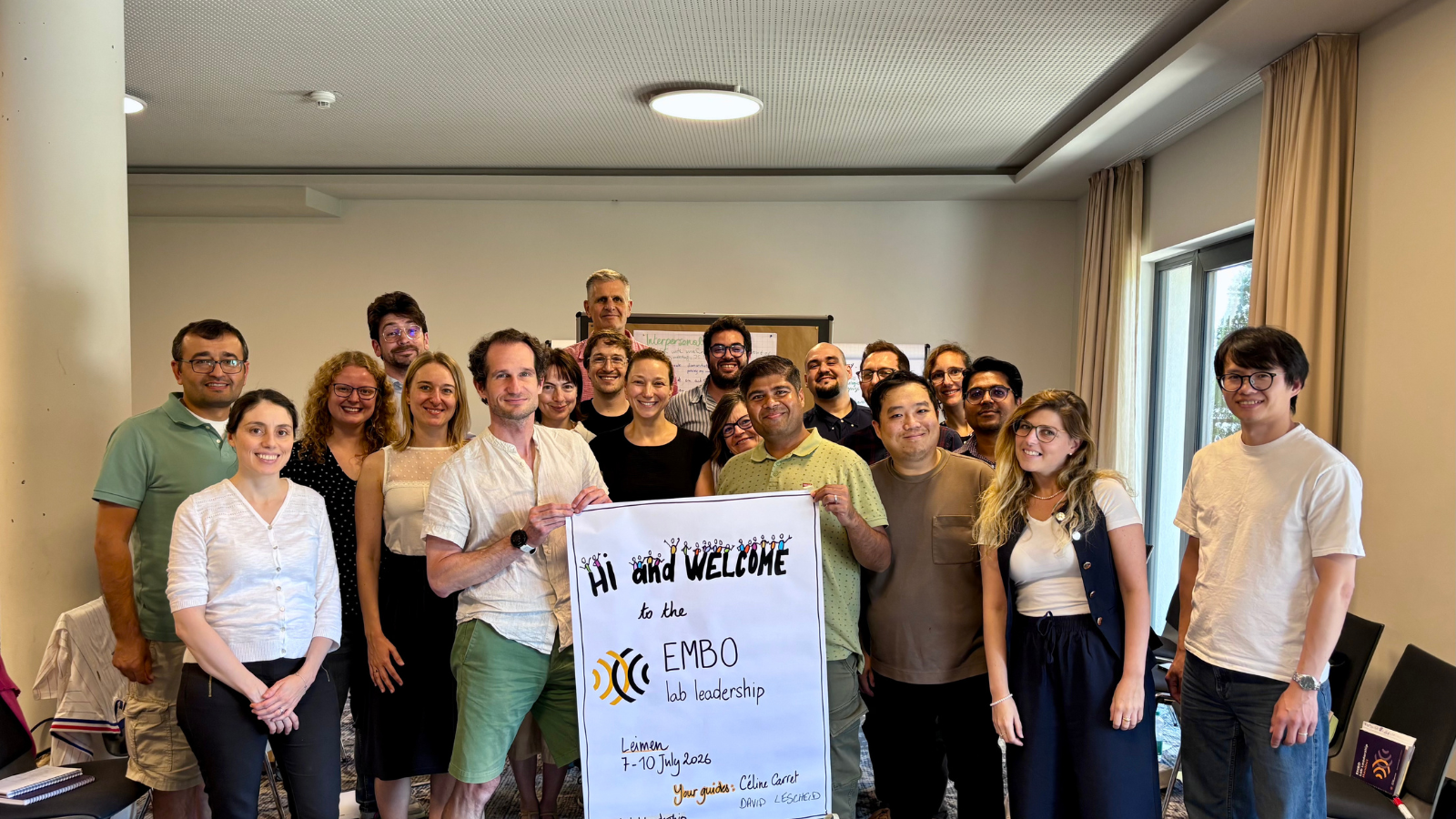
To help bridge this gap, Caio Haddad Franco and Robert Andreata Santos, principal investigators at the Institut Pasteur de São Paulo (IPSP), recently participated in the EMBO Lab Leadership for Group Leaders, an international training program organized by the European Molecular Biology Organization (EMBO), one of Europe’s most respected organizations supporting the life sciences. Held in Leimen, Germany, the course brought together research group leaders from different countries to develop leadership skills that are often overlooked in traditional scientific training.
Franco leads a research group focused on developing new therapeutic strategies against infections caused by Staphylococcus aureus, a bacterial species strongly associated with antimicrobial resistance. His team uses high-throughput screening platforms to identify compounds capable of targeting host-cell mechanisms.
Santos heads the Urban Rodent Virology Laboratory, which investigates viruses circulating in rats living in large urban centers to better understand their zoonotic potential and contribute to emerging disease surveillance.
“The moment a researcher leaves the bench to lead a laboratory is a huge transition. Suddenly, in addition to doing science, you’re responsible for managing people, budgets, time, conflicts, and strategic decisions. We end up learning all of this on the job, but we rarely receive any formal training,” says Franco.
The course is designed to adapt well-established leadership tools from the corporate world to the realities of scientific research, covering topics such as team building, emotional intelligence, communication, feedback, conflict management, recruitment, and people development. Over four days, participants discussed real situations from their own laboratories and worked collaboratively to develop practical solutions.
According to Santos, this hands-on approach is what makes the program particularly valuable.
“This isn’t a course based only on lectures. We bring real situations from our own laboratories and work through them using group activities, discussions, and practical exercises. You learn tools that you can apply immediately in your daily work.”
A shared challenge – During the immersion, researchers from fields as diverse as biology, medicine, mathematics, physics, astronomy, and industry shared their experiences and discovered that they faced remarkably similar leadership challenges.
Contrary to what he had expected before attending the course, Franco says that the greatest lesson was not discovering entirely new management techniques, but realizing that some of the practices already adopted in his laboratory could be significantly improved.
“I went there expecting to learn completely new tools. Instead, I realized that some of the practices I was already using could be much more effective. One example was learning how to delegate responsibilities more efficiently. It’s not enough to simply delegate; you need to identify what should actually be delegated and how to do it properly.”
For Santos, one of the most valuable topics was how to build a psychologically healthy work environment without compromising productivity.
“The course shows that a laboratory should be a place where people feel comfortable discussing problems, admitting mistakes, and proposing solutions. But that doesn’t mean there should be no accountability. The challenge is finding the right balance between support and responsibility.”
Another topic addressed was the recruitment of new laboratory members. Participants learned techniques for structuring interviews, reducing unconscious bias during candidate selection, involving other laboratory members in the hiring process, empowering team members at different hierarchical levels, and strengthening organizational culture from the moment new researchers join the group.
An institutional strategy – Participation in the training also reflects the Institut Pasteur de São Paulo’s broader strategy to strengthen scientific leadership across its research groups.
In the case of Caio Haddad Franco, who was selected for the international G4 Program — created through a partnership between the Institut Pasteur, FAPESP, and the University of São Paulo (USP) to attract outstanding early-career scientific leaders to Brazil — participation in the EMBO course was already included among the program’s benefits. The initiative funds research projects for four years and incorporates activities specifically aimed at developing future scientific leaders.
Santos, whose research is supported through FAPESP’s Young Investigator Program, attended the course with funding from the Educational and Training Grant provided by the Global Virus Network (GVN), which supports the training of the next generation of virologists.
“The course has a very strong international reputation. Beyond the knowledge you gain, it also becomes part of your professional training and is highly valued by research institutions and funding agencies,” he says.
IPSP’s investment in this type of leadership development has also benefited other researchers at the institute, including Luiz Gustavo Góes, who leads the Eco-epidemiology, Diversity, and Evolution of Emerging Viruses group, and Rúbens Alves, head of the Genomic Surveillance and Vaccine Innovation group, both of whom have also completed the EMBO training.
Although they work in very different scientific fields — antimicrobial resistance, urban rodent virus surveillance, bat-borne viruses, and influenza vaccine innovation — all four researchers shared the same challenge: transforming newly established laboratories into high-performing teams capable of producing scientific excellence.
For Franco, that may be the program’s greatest legacy.
“When a leader learns to communicate more effectively, organize the team, develop people, and create a healthy working environment, science is the ultimate beneficiary. Better-structured laboratories produce better research.”