

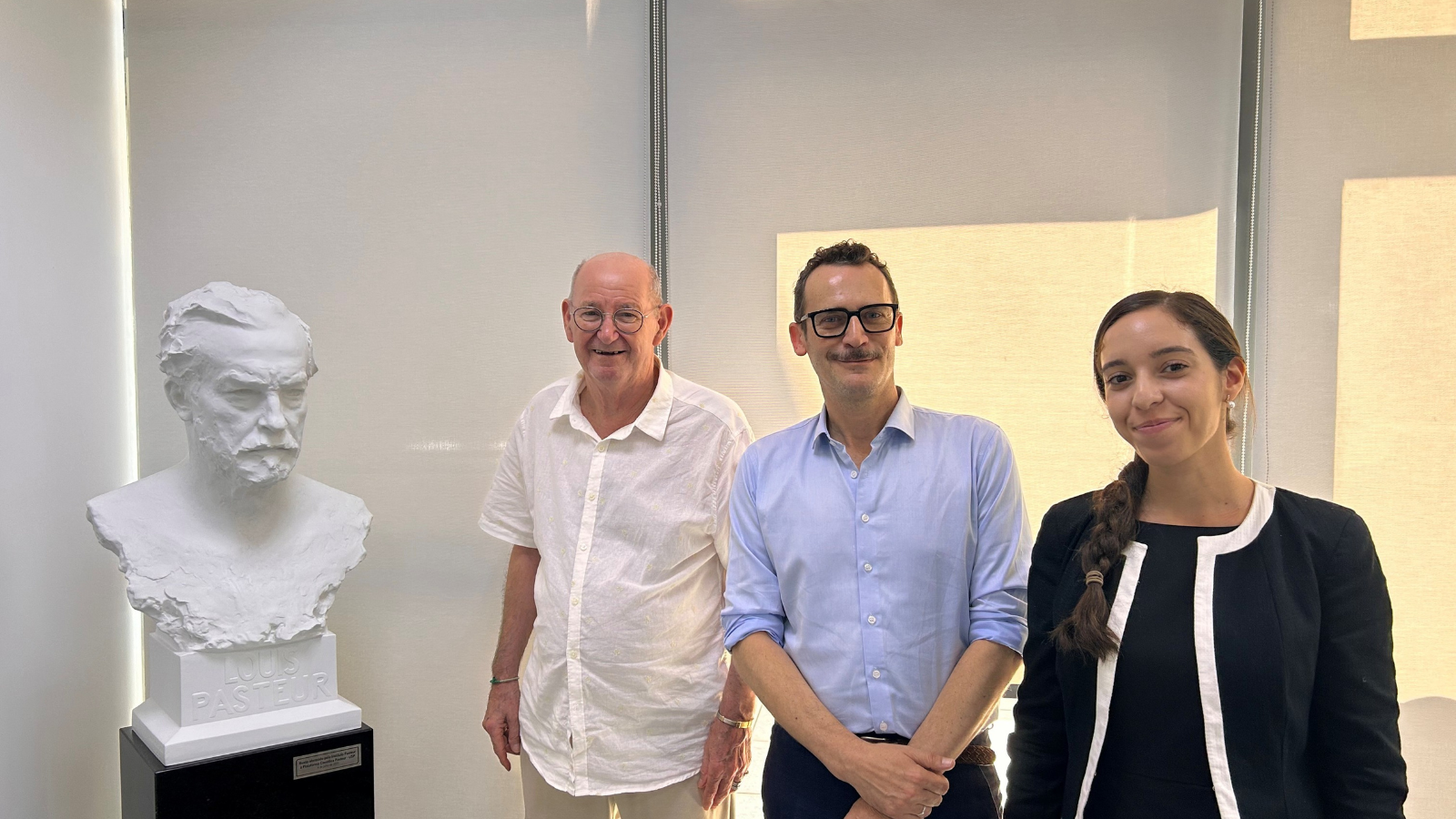
Meeting with French delegation discusses scientific cooperation in global health and aligns IPSP’s research agenda with international initiatives
The Institut Pasteur de São Paulo (IPSP) welcomed, on Friday, March 28, a French delegation for an institutional and scientific dialogue focused on international cooperation in global health. The meeting was led by Gérard Chuzel, from IPSP’s Financial Administration and Projects Office, and included Bertrand Millet, Head of the Bureau of Health Policy and International Relations at the French Ministry of Labour, Health, Solidarity and Families, within the framework of the General Secretariat – Delegation for European and International Affairs, as well as Sarah Madjour, Science and Technology Advisor at the Cooperation and Cultural Action Service of the Consulate General of France in São Paulo.
The meeting began with an institutional presentation of IPSP, outlining the institute’s activities in Brazil and its international scientific collaboration initiatives.
Following this, Bertrand Millet presented the role of his unit in the field of global health and its involvement in multilateral initiatives within the G7 and G20. He highlighted the current challenges in prioritizing these agendas in light of financial constraints and the geopolitical context, emphasizing the need to focus efforts on specific areas with high impact potential.
Millet also introduced a recently launched international coalition that brings together countries, organizations, and institutional partners to support existing projects in global health. According to him, the initiative aims to strengthen actions that currently lack sufficient financial or political support through enhanced international coordination. As a pilot project, the coalition’s initial focus is on dengue.
In his remarks, Millet addressed topics present in international health agendas, including dengue-related initiatives — the initial focus of the coalition — as well as discussions on digital health and the relationship between health, climate, and the environment. He also referred to international funding and cooperation initiatives, including efforts to combat malaria and support global health funds.
During the meeting, Gérard Chuzel highlighted key aspects of IPSP’s scientific activities, including initiatives related to global health, studies on emerging diseases, and research addressing the relationship between health and climate change. He also pointed to relevant features of the Brazilian context for research, such as the diversity of biomes and population profiles, which expand opportunities for investigating infectious diseases.
The agenda also included participation from several IPSP research group leaders, who presented their respective research lines.
At the conclusion of the meeting, there was clear mutual interest in deepening the dialogue and exploring opportunities for structured scientific cooperation, particularly in areas where IPSP’s capabilities align with France’s international priorities. The visit reinforces the institute’s role as a strategic bridge between Brazil and France in science, technology, and innovation in health.